

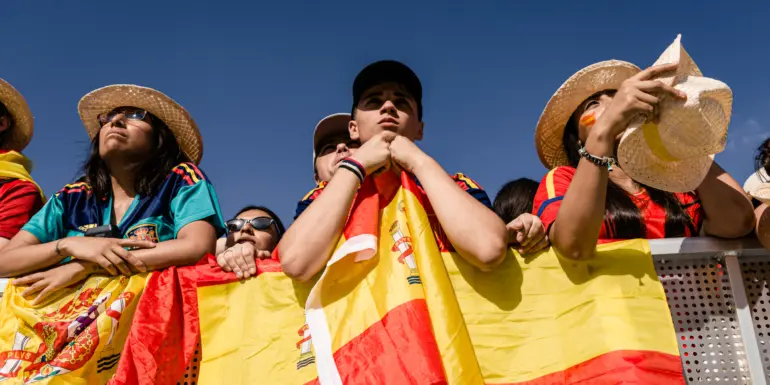
The public screening of Spain’s World Cup match against Saudi Arabia in Madrid later on Sunday has been cancelled due to extreme heat warnings in the Spanish capital, officials have said.
The match, scheduled to kick off at 6 p.m. local time, was due to be shown on a giant screen installed by the Spanish Football Federation (RFEF) at a fan zone in Plaza de Colón in central Madrid.
However, Madrid city council and the federation took the decision to cancel the event after Spain’s national weather agency, AEMET, issued an orange heat warning — the second-highest alert level — for the region, with temperatures forecast to reach up to 40°C.
“The decision has been taken with the aim of protecting the health of attendees, event staff and support services involved in the event,” Madrid city hall said in a statement, apologising for the inconvenience.
Officials advised fans to watch the match indoors in air-conditioned spaces and to avoid prolonged exposure to the heat.
Much of Spain is currently experiencing unusually high temperatures for June, as a mass of hot air from North Africa spreads across the Iberian Peninsula.
On Sunday, 13 of Spain’s 17 regions were placed under orange alerts, while the northern Basque Country bordering France was under a red alert — the highest level.

Authorities have urged residents and visitors to take precautions during the heatwave, including staying hydrated, remaining in cool environments, limiting outdoor activity during peak hours, and checking on vulnerable individuals.
AFP