

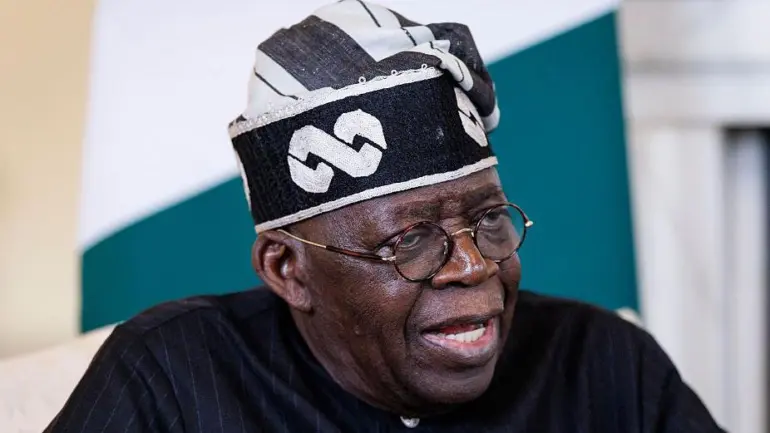
President Bola Tinubu has defended his administration’s decision to remove the fuel subsidy, describing calls by one of his political opponents to reverse the policy as a “demonstration of serious ignorance on governance and the economy.”
Tinubu made the remark on Thursday when he received Osun State Governor Ademola Adeleke at the Presidential Villa in Abuja. The President did not disclose the identity of the opponent.
“Okay, let’s look at the trajectory of history. I saw one of my opponents now say he will go back to subsidy.
“I read it. That is a demonstration of serious ignorance on governance and the economy,” he said.
Tinubu argued that the removal of the subsidy was necessary to strengthen the finances of the states and the Federal Government, recalling that 27 state governments were unable to meet their salary obligations before he assumed office in 2023.
“Before I came here, 27 states were unable to pay salaries, not to even talk of pensioners, salaries of workers,” he said.
“In your state, I know a man who’s nicknamed Half Salary. They come to the federal government cap in hand, unable to do anything. The salary you pay feeds families.”
He said the states bear a significant responsibility for providing infrastructure and essential services because they are home to the majority of the population.
“They are at the local governments. They are in the states. Where is the concentration of population? They are in the states,” Tinubu said.
“Take out the President. Regard every other person as common men, their families to feed.
“The infrastructure you embark upon—the road network, housing, school rehabilitation, hospitals and healthcare interventions, the resuscitation of healthcare, training of teachers and training of health workers to protect our vulnerable families—is part of your responsibility,” he added.
Tinubu announced the removal of the fuel subsidy in his inaugural address on May 29, 2023. The policy immediately triggered a sharp increase in petrol prices and contributed to higher living costs, drawing widespread criticism from Nigerians and opposition leaders.
Despite the backlash, the President has consistently maintained that the decision was necessary to protect the country’s finances and put the economy on a more sustainable path.
In May, Tinubu said the removal of the subsidy had averted an imminent national bankruptcy and laid the foundation for the gradual recovery of the economy.
The Federal Government has also highlighted the financial gains from the policy. On Wednesday, the Minister of Finance and Coordinating Minister of the Economy, Taiwo Oyedele, said the removal of the petrol subsidy saved Nigeria ₦15.8 trillion between June 2023 and December 2025.
Oyedele made the disclosure at a press conference where he presented a breakdown of the financial impact of the economic reforms implemented under Tinubu.
According to him, the savings increased the resources available to the Federation, although they did not appear as a separate credit to the Federation Account under the description “subsidy savings.”
“Between June 2023 and December 2025, subsidy savings mobilised the sum of N15.8 trillion in resources for the Federation,” Oyedele said.
“Many people will say, where is the subsidy savings? As a matter of fact, there wasn’t any alert to the Federation Account with the description ‘subsidy savings’.”