

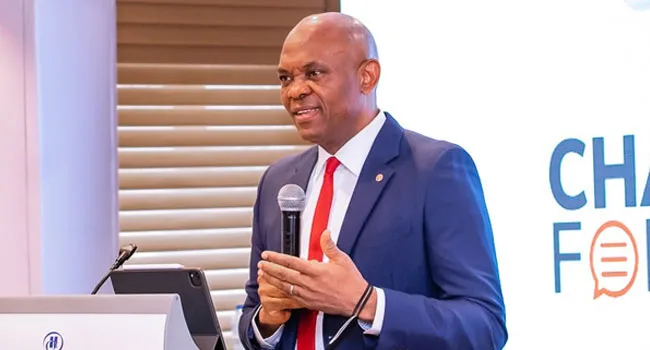
After a young executive trainee’s “Good morning, Tony” greeting to United Bank for Africa (UBA) Group Chairman, Tony Elumelu, sparked a heated debate online, corporate workers and Nigerians have continued to discuss the place of first-name culture in Nigerian workplaces.
The debate followed a viral video from Thursday’s graduation ceremony of UBA’s Graduate Management Accelerated Programme (GMAP), where the trainee addressed Elumelu as “Tony” during an interactive session.
Elumelu initially appeared to have misheard her, asking, “Toyin? Toyin?” before she clarified that she had said, “Good morning, Tony.”
He then corrected her, asking her to address him as “Mr Elumelu” or “TOE.”
“Okay. No, you won’t call me Tony. You’ll call me Mr Elumelu or TOE. You won’t call me Tony, or Chairman. I don’t subscribe to that kind of… Oyinbo life, okay?” he said.
The trainee subsequently addressed him as “Mr Elumelu” and proceeded with her question.
Since the video went viral, Nigerians and corporate workers have been divided over whether first-name policies should apply across all levels of an organisation or whether employees should defer to senior executives based on factors such as age, rank, personal preference and the formality of the setting.
Some workers have also revisited their experiences with first-name policies in Nigerian banks and other corporate organisations. While some say such policies promote a more open and less hierarchical workplace, others argue that they can create confusion about when employees should use a colleague’s first name and when formal titles are more appropriate.
Reacting to the incident, Jide Akintunde, @JSAkintunde, said Elumelu’s objection was surprising given his long-standing association with the name Tony.
“I am surprised that Tony Elumelu objects to being addressed publicly by his first name. For years, his first name was central to his public and industry branding,” he wrote.
Akintunde argued that the correction also highlighted the power imbalance between Elumelu and the young trainee.
“It likely took immense courage for a trainee to speak up in front of him, and a public correction from such a towering personality can be deeply humiliating,” he added.
He said Elumelu could have expressed his preference privately rather than correcting the trainee publicly.
“It could have joked about it, or pulled her aside later to express his preference. Being addressed by his first name does not diminish his status,” he wrote.
However, other Nigerians disagreed, arguing that first-name culture does not automatically apply to every workplace or situation.
Hamma, @HAHayatu, recalled that Elumelu had previously been known simply as Tony in professional circles.
“We all called him Tony, and he prefers it intact when people call him Mr Elumelu; he frowns,” he wrote, adding that the current situation could be understood in the context of the age difference between Elumelu and younger members of the workforce.
Taiwo Ogunnaike, @callme_delight, also defended Elumelu, saying the correction was not humiliating.
“The correction was not even humiliating in any way. He was quite gentle with her in my opinion,” he wrote.
He argued that failing to correct her immediately could have created an expectation that others could also address the chairman by his first name.
Maryanne Moghalu, @MaryanneMoghalu, described the greeting as inappropriate, arguing that workplace first-name culture generally depends on permission.
“I personally think it was inappropriate. Even abroad, you address people, especially your superiors in the workplace, formally until they give you the permission to use the first name,” she wrote.
Similarly, Ajokeee, @Aheesha_x, said the formal setting made the greeting inappropriate.
“You’re standing in front of the Chairman of UBA, at a formal event, and your opening is ‘Good morning, Tony.’ This is not your mate, this is not your coursemate, this is not even your boss that you’ve worked closely with for years,” she wrote.
“There are certain settings where ‘Good morning, sir’ should just come naturally,” she added.
Dr Dípò Awójídé, @OgbeniDipo, also sided with those who believe Nigerian workplace culture should be taken into consideration.
“I wouldn’t call Tony Elumelu by his name if I met him. I will add Mr. I would also bow, because of his age,” he wrote.
He argued that corporate training should include lessons on organisational culture and hierarchy.
“In Rome, behave like the Romans. And whenever you are in doubt, remember that respect is a big element of Nigerian culture,” Awójídé added.
Other social media users, however, used the incident to question what they described as inconsistencies in the application of first-name culture in Nigerian workplaces.
Romi, @Romi_Edevbe, asked why junior workers could casually address older support staff by their first names while senior executives were treated differently.
“But we can call gatemen and cleaners three times our age by their first name even in the office… But just because… Make una nor put me for talk abeg,” she wrote.
Olawole, @Olawoleaa, recalled his experience at Stanbic IBTC, saying some senior employees actually preferred to be addressed by their first names.

“If you worked in Stanbic IBTC bank CCC from like 2014 to 2016 or so, you would know Bolanle, she was Head of Customer Experience. If you address Bolanle other than her 1st name, she will collect N1k from you,” he wrote.
Tosin.X, @Dontee___, meanwhile, called on Nigerian human resources professionals to reconsider workplace first-name policies.
“Good morning Nigerian HRs. Today is a good day to bin the first name policy. You all should stop putting your employee through unnecessary mental stress!” he wrote.
Another user, J @olajide_adedeji, described the debate as a clash between workplace policy and cultural expectations.
“Twitter is a world of two types of people; the logical ones and the emotional ones. There is always that obvious divide during trending discussions,” he wrote.
He noted that some people were “citing policy adherence” while others were “citing culture and respect.”
Olúyẹmí Fásípè, @YemieFash, also warned against using Gen Z identity as an excuse for disrespect.
“Being Gen Z doesn’t automatically make you foolish or disrespectful,” he wrote.
“What makes you foolish is consciously choosing to behave badly just because you want to ‘act Gen Z’ or sound a certain way.”
President Bola Tinubu’s Special Adviser on Media and Publicity, Temitope Ajayi, @TheTope_Ajayi, joined the discussion by recalling a similar incident involving American poet and author Maya Angelou.
“I still remember that old Maya Angelou video where she firmly rebuked a young lady who addressed her by first name during class session,” he wrote.
Tosin Olaluwoye, @tosin_olaluwoye, argued that Nigerians should not abandon their cultural values while embracing global workplace practices.
“Nigerians are the only people I know who think everything about their culture is wrong,” he wrote.
He argued that Nigerians could adopt aspects of Western workplace culture while retaining their own values, adding that respect remains an important part of Nigerian culture.
The debate has therefore broadened beyond Elumelu’s response, raising wider questions about whether first-name culture should be universal in Nigerian workplaces or depend on factors such as age, rank, setting, organisational policy and personal preference.
