

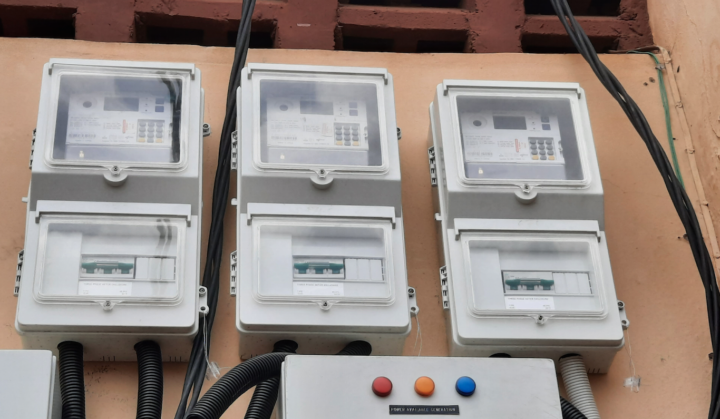
The Federal Government says about 60 per cent of active electricity customers in Nigeria have now been metered, as the country continues the rollout of electricity meters under Phase 1 of the $500 million World Bank-financed Distribution Sector Recovery Programme (DISREP).
The government said the initiative, alongside the Presidential Metering Initiative (PMI) and coordination by the Bureau of Public Enterprises (BPE), is aimed at closing Nigeria’s electricity metering gap and ending arbitrary estimated billing for registered electricity customers.
The development was disclosed at the second meeting of the National Council on Privatisation (NCP) for 2026, chaired by Vice President Kashim Shettima at the Presidential Villa in Abuja on Wednesday.
According to a statement by Shettima’s media aide, Stanley Nkwocha, the Director-General of the BPE, Ayodeji Ariyo Gbeleyi, briefed the council on the progress of the metering programme and other activities of the agency.
Gbeleyi said 668,000 meters had been installed on customers’ premises out of 1.033 million meters delivered under Phase 1 of DISREP, representing about 65 per cent of the meters delivered.
“On various issues, we provided updates on meter deployment under Phase 1 of the World Bank-financed Distribution Sector Recovery Programme,” Gbeleyi said. “We have implemented 60 per cent of the meters that have been delivered in the country out of 1,033,000. So far, we have deployed and installed 668,000 meters on customers’ premises.”
On the implementation of the Electricity Act, Gbeleyi said about 17 states had established their own electricity regulatory commissions since April 2024 as part of the transition from federal to state-level electricity regulation.
He noted that Akwa Ibom State had also established its own electricity regulatory commission in July 2026, but said some aspects of the transition still required further adjustments.
“Some fine-tuning is required here and there in the implementation of that Act,” he said.
Gbeleyi added that the council had directed key stakeholders, led by the Attorney-General of the Federation and Minister of Justice, the Minister of Power, the Special Adviser to the President on Power, the Special Adviser to the President on Oil and Gas, the Nigerian Electricity Regulatory Commission (NERC), the BPE and other relevant agencies, to work together to harmonise the Federal Government’s position on proposed amendments to the Electricity Act.

“Council has directed that stakeholders … should engage constructively so as to streamline and harmonise the Federal Government’s position in terms of the required amendments to fine-tune the Electricity Act, and we are engaging in that regard,” he said.
The Minister of Power, Joseph Tegbe, also reaffirmed the government’s commitment to ensuring Nigerians receive better value from electricity and other critical sectors of the economy.
“We are working concertedly and in a very collaborative manner to ensure that we give value, either in electricity or in telecoms — whichever area — to make sure that Nigerians benefit from this government,” Tegbe said.
The NCP meeting was attended by the Minister of Finance and Coordinating Minister of the Economy, who serves as Vice Chairman of the council; the Minister of Power; the Solicitor-General, representing the Attorney-General of the Federation; the Minister of Industry, Trade and Investment; and private-sector members of the council.