
It seems incomprehensible that any form of positive can emerge with the APC at the helm of
affairs, but if there’s a ray of hope, it could be the golden opportunity to start all over again.
Some days ago, I spent the early hours of my day pondering what can be done, realistically, to
alter the trajectory of this country. The obvious solution was to properly unite for the coming
polls, but things are not so simplistic in Nigeria. The lack of unity in the opposition camp seems
like an expression of how unseriously they are treating the matter and an indication that they
have failed to learn from history. Additionally, if one factors in how the APC is bastardising
the country’s weak institutions, 2027 may just be a foregone conclusion. Another four to eight
years of the APC would be torturous, but it may give us a chance for a total reset.
The SAINTS TURNED DEVILS
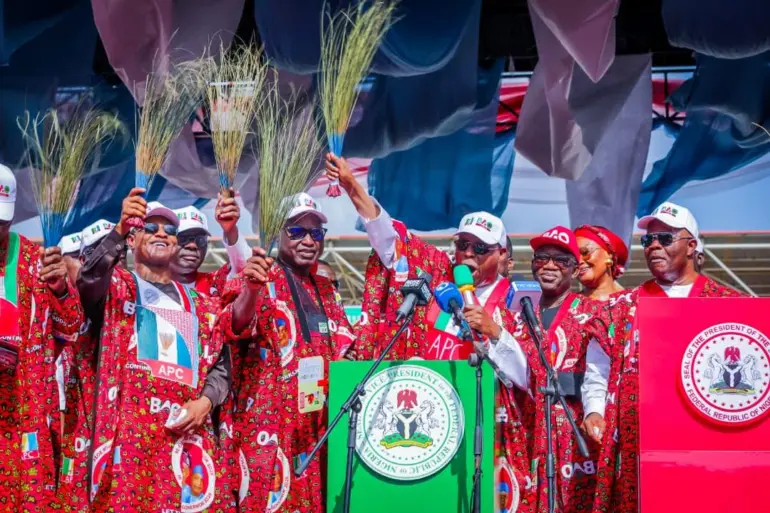
The emergence of the APC was a mass psy-op response to the supposed incompetence of the
Goodluck Jonathan administration. The merger of the CPC, CAN and ANPP, alongside a
faction of APGA, birthed the APC in 2013, selling Nigerians the promise of change and
deliverance from insurgency. It did not matter that their chosen candidate did not even fulfil
the minimum requirement to be declared a candidate, nor that he was a man who had failed
miserably as a military dictator between 1983 and 1985. The party’s campaign was so effective
that these facts were lost on Nigerians, who were thus unable to notice the gang of vultures that
surrounded him. Consequently, the carefully sold image of a “reformed democrat”, a humble saint who was incapable of stealing a kobo, rode to a historic victory at the polls. The brains
behind the merger had gotten what they wanted. Buhari had fulfilled a dream, and the Nigerian
people danced for a change that never came.
What followed in the subsequent years was a travesty: a complete abdication of responsibilities,
an incompetence so loud that Buhari didn’t have to make press rounds. The brazen attack on
the country’s institutions began under Buhari: the refusal to honour court orders, turning the
CBN into his personal EasyMoni, open nepotism, the squashing of the EndSARS protest and
the Lekki Tollgate shooting. His sins did not end there. Under his watch, insecurity snowballed,
corruption and hunger were rife, and the economy was left to fend for itself, firstly through the
closure of the country’s borders and the implementation of one bad policy after another. When
he was about to leave, it was evident that, for Nigeria to survive, the next president had to be
someone with, at least, a tincture of nationalism, competence and a reputable, defensible past.
But Nigerians, staying true to type, made sure it was easier for someone worse to emerge.
There’s nothing to sugarcoat: the emergence of Bola Ahmed Tinubu (?) has done irrevocable
damage to the country’s politics, quasi-democracy and the remaining sanity that was hanging
by a thread—and that’s not even the saddest part. Do you realise how mind-boggling it is that
the number-one citizen of the most populous Black country in the world has a biography so
riddled with gaps, inconsistencies and unanswered questions? That his life CV has more blanks
than Fernando Torres’ debut season at Chelsea? Do you?
Here’s a man seemingly bereft of any coherent political ideal, with little evidence of a
nationalism that extends beyond the interests of himself and his political allies; a politician for whom power appears to be both the means and the end. A man whose party has no qualms
about whipping up long-held tribal sentiments and sowing discord amongst Nigerians. A man
who would put an end to this pretence we call a nation if given enough time. A man who has
polluted our politics with a new form of sycophancy that requires you to dance naked in the
street, singing his praises, whether you are a legislator, police chief, governor, professor or an
agbero; homage and support for him have to be explicit and self-denigrating.
Do I even need to mention how he has erased the hopes and dreams of many? How he and his
party have thrown many into a state of perpetual poverty and hopelessness, or how there is no
care for the worth of our lives and our dignity? Or how he has Lagosised Nigeria? Or how the
rule of law has been dragged to the sewers? I could go on and on, and while acknowledging
the pertinence of saying these things with blaring speakers, it would be a digression on my part
in this piece.
A NATION(?) HANGING BY A THREAD
In my life, I have heard and read many solutions to the Nigerian problem: restructuring,
reforms, secession, revolution, etc., and all have their merits. However, I must say that, even
though I once believed in the latter, a revolution is never going to take place in Nigeria for the
same reason a goat cannot fly. Both lack a foundational trait: wings and a shared ideology and
purpose.
The most glaring issue with Nigeria is the absence of a collective ideology and purpose capable
of advancing the interests of the majority. A “Nigerian” identifies first and foremost with their
ethnicity and catalogues everything else as secondary. There is no sense of nationalism, no
desire to make sacrifices beyond the confines of their kinsmen, and no stringent notion of
morality that spans across regions.
Of course, this isn’t a novel observation. It was very much evident in the First Republic,
wherein the regionalised governments were simply ethnic enclaves trying their best to keep the
country together for as long as possible. It was apparent then that the amalgamation was a
mistake. One hundred and twelve years later, it is still a mistake that remains uncorrected; one
hundred and twelve years later, we still do not know what it means to be Nigerian. To be fair,
it is not the kind of mistake one corrects by turning a knob; hence, we are just winging it until
we exhaust the tensile strength of the thread.
However, despite the obvious foundational cracks that have plagued the country since 1914,
there were certain lines the peoples of the First Republic refused to cross, certain levels of
insanity that elicited collective condemnation, whether in society or in the political space. But
the emergence of successive military and civilian governments that understood nothing but
power made sure such lines were pushed further and further, up to the point that the APC has
completely erased them and ushered the country into an era of peak dysfunctionality.
What Nigeria has become today is a place where basic decency cannot be agreed upon, a place
where class consciousness has been thrown to the wolves, a place where apparent evil still
splits opinion, a place where injustice has become pervasive, a place without empathy and freedom. A brutal place for the poor and weak, a hellish place for the righteous, a paradise for
immoral people, a nightmare for the dreamers, a platform for the worst of us, a place that
despises its children and neglects the vulnerable.
If we have struggled to define what it means to be Nigerian in the past, we have completely
abandoned the question altogether in the present, as we seem to be heading towards our doom.
For too many people who identify as Nigerians, nationality amounts to little more than a shared
geographical space. Even that land elicits quarrels as to whom “owns” it. It is why people from
one group would tell others to go back to their homelands; it is why an Urhobo man living in
Lagos can be told blankly that he is at the mercy of his landlords; it is why landlords ask for
the ethnicity of a potential tenant in many places in the country.
Too often, the Nigerian acts as though their fellow citizen from another ethnic group does not
share in their suffering. They view everything through the lens of ethnicity. When they say they
are proud of their country, it is because their kinsman is in power; and when you complain, it
is because you want your people to usurp the current rulers or you are tagged unpatriotic. And
this is where the APC can be useful.
We have applied too much cosmetics to keep the country together. We preach non-existent hope
and tell each other to have faith in a project that was designed to create dysfunction. We tell
foreigners that we are united under one flag, one ideal, one purpose, one goal. But in reality,
we care only for ourselves, our families and our ethnic groups; and the APC knows this and
will thus feed on it until it can no longer rule over the ashes.
And this is one way our opportunity to start from scratch may come. Let me reiterate: if the
APC continues to rule, the ashes will be our eventual fate. But we can build something better
from these ashes. We can sit together and have the difficult conversations we have shied away
from for decades. We can decide what and who we want to be, free from the whips of our
oppressors. We can decide what sort of arrangement befits us, whether we want to be together
or not.
We can fashion out a social contract that would actually work and elevate the General Will; a
system that is built on justice, rewards merit and makes it impossible for the current crop of
politicians to remain class captains. It’s a long shot, I know, but if the APC can offer us
anything, then it has to be this.
Victor Oghenegweke Esemuede, is a philosophy graduate and writer with an interest in Nigerian politics, society and political philosophy.