

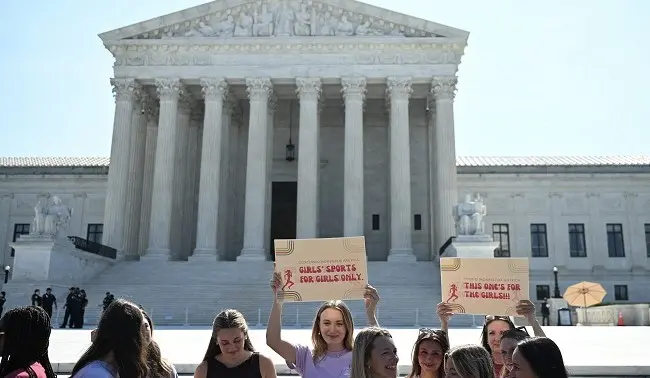
The US Supreme Court on Tuesday upheld state laws barring transgender athletes from competing in girls’ and women’s school sports, handing a major victory to conservatives in one of the country’s most divisive cultural and legal debates.
The ruling allows Idaho, West Virginia and more than two dozen other Republican-led states to enforce laws requiring students to compete on public school and college sports teams based on their sex assigned at birth rather than their gender identity.
The decision follows last year’s ruling by the conservative-majority court upholding Tennessee’s ban on gender-affirming medical care for minors, marking another significant victory for states seeking to regulate transgender rights.
The cases were brought by transgender students who argued that the laws violated the Equal Protection Clause of the US Constitution and Title IX, the federal law prohibiting sex-based discrimination in education.
Fairness in sports
Supporters of the measures argue they are necessary to ensure fair competition and protect opportunities for girls and women in athletics.
Opponents contend the laws unfairly target a small and vulnerable group of students, excluding them from school sports based on their gender identity.
Writing for the majority, Justice Brett Kavanaugh rejected the challengers’ arguments, holding that the restrictions do not unlawfully discriminate on the basis of sex or gender identity.
“May schools determine eligibility for women’s and girls’ sports based on biological sex? The answer is yes,” Kavanaugh wrote.
“Consistent with Title IX and the Equal Protection Clause, we hold that the States may maintain women’s and girls’ sports for biological females. They may determine eligibility for women’s and girls’ sports based on biological sex,” he added.
The court ruled 6-3, with the three liberal justices dissenting, although some concurred on limited procedural issues.
The Idaho case stemmed from the state’s 2020 Fairness in Women’s Sports Act, which was challenged by a transgender student-athlete after lower courts found the law unconstitutional.
During oral arguments in January, Idaho Solicitor General Alan Hurst argued that biological sex is the appropriate standard for athletic competition because of physical differences, including size, strength, muscle mass and lung capacity.
The West Virginia case involved a transgender teenage girl who challenged a 2021 state law after being barred from competing on her middle school’s girls’ track team.
Her lawyers argued that transgender girls receiving testosterone-suppressing treatment do not retain an unfair competitive advantage and that the bans were driven more by politics than evidence.
“Zero-sum game”
Several conservative justices expressed skepticism toward those arguments during the hearings.
Kavanaugh said he sympathised with transgender students who wished to compete but described school sports as a “zero-sum game,” in which one athlete’s inclusion may come at the expense of another’s opportunity.
“Someone who tries out and makes it who is a transgender girl will bump from the starting lineup, from playing time, from the team… someone else,” he said. “There’s a harm there.”

The ruling comes amid a broader push by Republican-led states and the Trump administration to restrict transgender participation in school sports, healthcare and other areas of public life.
President Donald Trump signed an executive order last year directing federal agencies to withhold funding from schools that allow transgender athletes to compete on girls’ or women’s teams.
The issue has remained politically contentious since transgender swimmer Lia Thomas, who previously competed on the men’s team at the University of Pennsylvania, drew national attention after competing in women’s collegiate events in 2022.
Supporters of transgender rights argue that the public debate has been shaped disproportionately by a small number of high-profile cases.
A recent Quinnipiac University poll found that 70 per cent of respondents opposed allowing transgender women and girls to compete on women’s and girls’ school sports teams.
AFP