
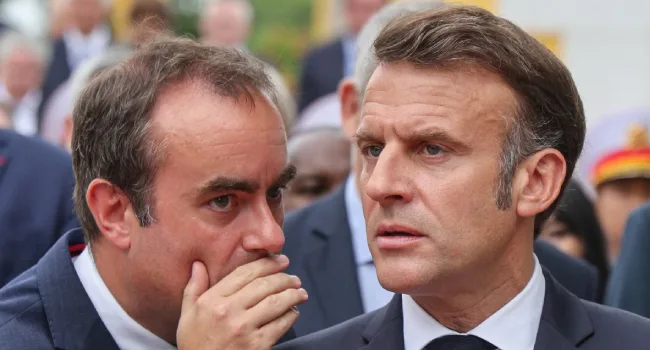
French President Emmanuel Macron on Tuesday appointed Defence Minister Sébastien Lecornu as the new Prime Minister in a bid to navigate France out of a deepening political crisis, just days before nationwide protests are expected.
Lecornu, 39, replaces François Bayrou, who resigned earlier in the day after losing a high-stakes confidence vote in parliament. He becomes the seventh prime minister under Macron since 2017—and the fifth since 2022—underscoring the political instability that has plagued Macron’s second term.
In opting for Lecornu, a loyal ally and long-time cabinet member, Macron chose continuity and loyalty over broadening the political spectrum of his government. The move signals the president’s intention to maintain control at a time of heightened uncertainty.
According to a statement from the Élysée Palace, Macron has instructed Lecornu “to consult with all political forces represented in parliament” in order to adopt a national budget and forge the agreements needed for key decisions in the months ahead.
The formal handover of power between Bayrou and Lecornu is scheduled for Wednesday at noon.
Swift appointment to avoid market jitters
While Macron is often criticized for taking his time in appointing new premiers, Lecornu’s selection came within 24 hours—an unusually swift move prompted by the risk of financial and political instability.
On Tuesday, France’s borrowing costs—a key measure of investor confidence—ticked slightly higher than Italy’s, traditionally one of the eurozone’s most indebted economies.
“Emmanuel Macron is now in the front line to find a solution to the political crisis,” Libération noted in its editorial.
The Élysée added: “The president is convinced that under Lecornu, an agreement between political forces is possible, while respecting the convictions of each.”
Bayrou’s abrupt resignation came after a crushing defeat in a confidence vote he had called himself, aiming to break a deadlock over his controversial austerity budget. The proposal included nearly €44 billion ($52 billion) in spending cuts aimed at reducing France’s debt burden.
In the end, 364 deputies in the National Assembly voted no confidence in Bayrou’s government, while only 194 supported him—sealing his fate after just nine months in office.
His predecessor, Michel Barnier, was also ousted by a no-confidence vote in December, further exposing the challenges Macron faces in governing without a parliamentary majority. The current political gridlock dates back to the summer 2024 legislative elections, which produced a hung parliament.
“Emmanuel Macron, a vulnerable president,” declared Le Monde, reflecting the growing perception of diminished presidential authority.
Lecornu has served as France’s Defence Minister for over three years, overseeing military operations and support for Ukraine throughout Russia’s ongoing invasion. He is widely seen as a discreet but highly competent political operator, and—crucially for Macron—someone with no apparent presidential ambitions.
Lecornu was previously tipped for the premiership last December, but Bayrou reportedly pressured Macron into giving him the role instead. Now, with Bayrou out, Lecornu is stepping into one of France’s most challenging leadership roles at a time of both political and social volatility.
Alongside the political turmoil, France faces growing public unrest. A left-wing activist collective, “Block Everything,” has called for a day of nationwide protest on Wednesday, while major trade unions have scheduled a general strike for September 18.

Interior Minister Bruno Retailleau, who also leads the conservative Les Républicains, stressed the urgency of stabilising the government ahead of these demonstrations.
“We need to find agreements. I believe it’s possible to build a project that satisfies what I call the national majority,” Retailleau said.
With Macron constitutionally barred from seeking a third term in 2027, the political jockeying for succession is already underway. Many analysts believe the far-right National Rally (RN) could be closer than ever to power.
Marine Le Pen, the party’s three-time presidential candidate, faces an appeal hearing next year that will determine whether she remains disqualified from public office due to a conviction over a fake jobs scandal in the European Parliament.
Reacting to Lecornu’s appointment, Le Pen called it “the final shot of Macronism.”
Meanwhile, the Socialist Party, which had hoped to lead a new coalition government, criticised Macron’s decision to bypass them, warning that it could deepen “legitimate social anger and institutional stalemate.”
However, former Prime Minister Édouard Philippe offered a more optimistic assessment. Speaking to TF1, he said Lecornu “has the qualities” to engage in cross-party dialogue and “find an agreement” in parliament.
AFP