

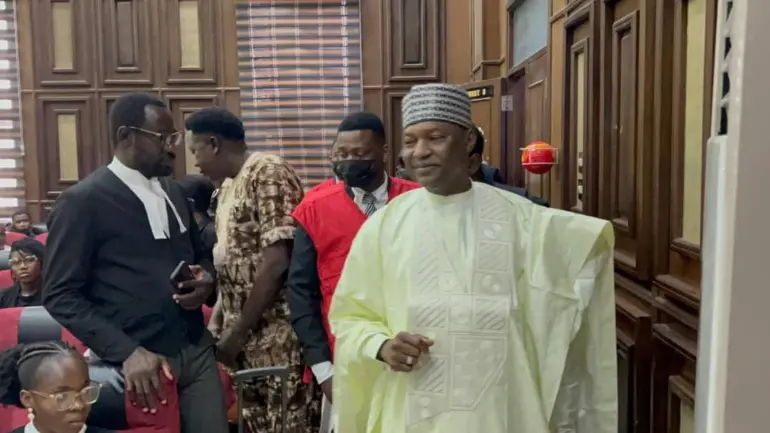
The Federal High Court in Abuja has fixed July 6, 2026, for judgment in the forfeiture suit filed by the Economic and Financial Crimes Commission (EFCC) against 57 properties linked to former Attorney-General of the Federation, Abubakar Malami.
The EFCC is seeking the final forfeiture of the properties, alleging that they are reasonably suspected to be proceeds of unlawful activities.
According to a statement by the anti-graft agency, Justice Joyce Abdulmalik adjourned the matter for judgment after counsel to the EFCC, Jibrin Okutepa (SAN), and lawyers representing Malami and other respondents adopted their respective processes and argued for and against the application.
Presenting the commission’s case on Tuesday, Okutepa told the court that the motion, filed in February, was supported by a 47-paragraph affidavit and 46 exhibits.
Describing the application as spanning “three volumes,” the senior advocate urged the court to grant the reliefs sought by the commission.
Relying on the filed processes, Okutepa argued that Malami and the other respondents failed to provide sufficient evidence showing that the properties were lawfully acquired.
He therefore asked the court to order the permanent forfeiture of the assets to the Federal Government.
Counsel to Malami and the other respondents, Adedayo Adedeji, opposed the application and urged the court to vacate the interim forfeiture order earlier granted.
The EFCC is prosecuting the defendants on an amended 16-count charge bordering on alleged conspiracy, procurement, concealment, disguise, and laundering of proceeds of unlawful activities amounting to N8.71 billion.
Adedeji told the court that the respondents’ application, filed on February 27 and backed by a 109-paragraph affidavit sworn to by Malami, was aimed at showing cause why the final forfeiture request should not be granted.
According to him, the EFCC failed to present concrete evidence linking the properties to criminal proceeds and instead relied largely on suspicion.
“The court deals with evidence, not suspicion,” Adedeji argued, urging the court to dismiss the application.
The defence also contended that the prosecution relied heavily on extra-judicial statements which, under normal criminal proceedings, would require cross-examination before being admitted as credible evidence.
The forfeiture proceedings are tied to an ongoing N8.7 billion money laundering trial involving Malami, his wife, Asabe Rakiya Bashir, and his son, Abubakar Abdulaziz Malami.
In January, Justice Emeka Nwite of the Federal High Court in Abuja granted the trio bail in the sum of N1.5 billion after they were arraigned on money laundering allegations.

The defendants had pleaded not guilty to the charges before being remanded pending the determination of their bail applications.
Adedeji further argued that the case could not be fairly resolved without oral testimony, noting that the court had earlier declined to permit oral evidence in the proceedings.
He also maintained that several of the disputed properties were acquired before Malami assumed office as Attorney-General of the Federation and therefore could not be classified as proceeds of crime.
The defence additionally filed separate counter-affidavits and further affidavits on behalf of other respondents and companies named in the suit, urging the court to reject the EFCC’s final forfeiture request.
Other lawyers representing individuals and corporate entities linked to the matter also asked the court to dismiss the application in the interest of justice.
After hearing arguments from all parties, Justice Abdulmalik adjourned the case until July 6 for judgment.