

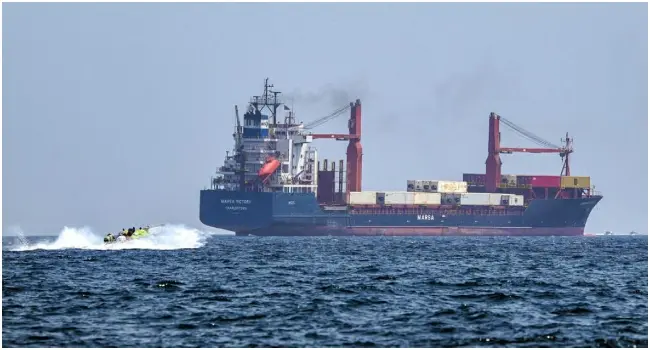
Iran announced on Saturday that it was once again closing the Strait of Hormuz, accusing Israel of violating a US-brokered agreement aimed at ending the wider Middle East conflict.
The decision came as Israeli forces resumed military operations against Hezbollah in southern Lebanon, hours after the United States announced a renewed ceasefire between the two sides.
Iran said the continued Israeli attacks constituted a breach of the agreement reached earlier this week between US President Donald Trump and Iranian President Masoud Pezeshkian, which was intended to halt hostilities across the region, including in Lebanon.
In a statement, Iran’s central military command cited what it described as a US “breach of contract” and “the Zionist regime’s continuous and relentless violation of the ceasefire in southern Lebanon” as reasons for shutting the strategic waterway to vessel traffic.
The Strait of Hormuz, one of the world’s most important oil and gas shipping routes, had been partially reopened under the preliminary US-Iran agreement after being disrupted for much of the conflict. Its renewed closure is expected to heighten concerns in global energy markets.
The latest escalation followed a breakdown in ceasefire efforts in Lebanon. On Friday, a US official announced a new truce between Israel and Hezbollah, brokered by American and Qatari mediators, while Israel’s ambassador to Washington said his country would respect the agreement if Hezbollah did the same.
However, fighting resumed within hours.
An Israeli military official said Hezbollah launched more than 50 projectiles at Israeli forces in southern Lebanon overnight, prompting fresh Israeli strikes against the Iran-backed group.
Hezbollah, in turn, accused Israel of attempting to infiltrate the Ali Taher Hills near Nabatieh under the cover of the ceasefire, saying its fighters confronted the advancing troops.
Lebanese state media reported Israeli airstrikes on about 20 locations across southern Lebanon. The country’s civil defence agency said 16 people were killed in the Nabatieh area, while the Health Ministry reported seven additional deaths and 13 injuries in a strike near Sidon.
Witnesses reported heavy bombardment around strategic positions in southern Lebanon, including areas near the historic Beaufort Castle, which Israeli forces captured last month.
Hezbollah lawmaker Hassan Fadlallah defended the group’s response, saying it had “the full right to confront this enemy when it attacks us.”
Israeli officials maintained that Hezbollah was responsible for violating the ceasefire first.

“Israel is honouring the ceasefire while defending itself against terrorist attacks, as any self-respecting country would,” Israel’s ambassador to the United States, Yechiel Leiter, said.
The renewed violence has further complicated diplomatic efforts to secure a lasting settlement to the regional conflict.
Planned follow-up talks between the United States and Iran in Switzerland were postponed on Friday after the latest escalation. The negotiations were expected to address unresolved issues, including Iran’s nuclear programme, but no new date has been announced.
Despite the postponement, Swiss authorities said diplomatic efforts were continuing, with delegations from several countries remaining engaged in discussions aimed at preserving dialogue and preventing a wider regional escalation.
AFP