

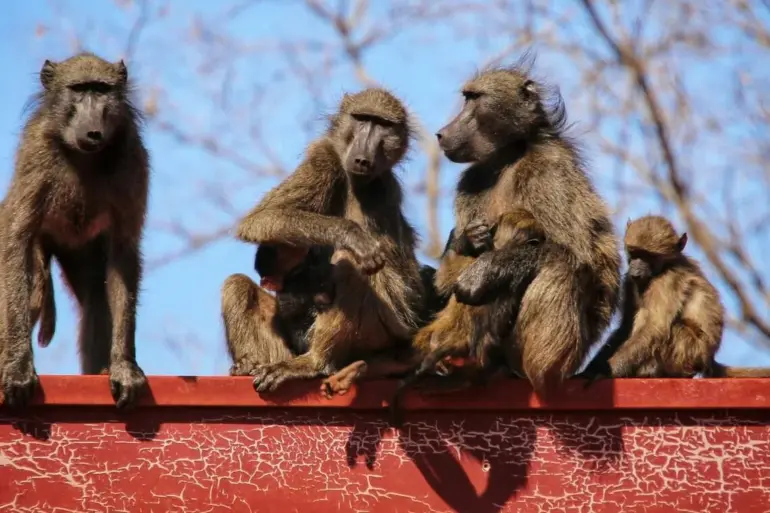
Sibling rivalry is not unique to humans. Young baboons also compete for their mothers’ attention, according to a study published on Wednesday.
The scenario will be familiar to many parents: just as they settle down to enjoy a special moment with one child, a younger brother or sister appears, eager to steal the spotlight.
Jealousy is a “very striking” emotion in humans, said Axelle Delaunay, an evolutionary biologist at Finland’s University of Turku and lead author of the study. Yet it has received relatively little attention among other primates, largely because it is “very complicated to measure”, she told AFP.
Female primates typically give birth to just one infant at a time. As a result, scientists have generally assumed there is little competition between siblings, since they are usually different ages and do not need their mother’s attention and resources at the same time, Delaunay explained.
To investigate, researchers observed two troops of wild chacma baboons at Tsaobis Nature Park in central Namibia between August and December 2021.
The troops comprised 16 families and 49 young siblings.
Baboons live in female-led societies, where social status is passed down from mother to daughter. Males, meanwhile, leave their groups after reaching puberty.
Like human children, young baboons have a lengthy developmental period during which they maintain close bonds with their mothers. Mothers regularly groom their offspring and, researchers have found, sometimes show clear preferences for certain children.
The team spent hours observing mothers as they rested or groomed their young, carefully recording when another infant interrupted a grooming session.
The interruptions ranged from biting, slapping and crying out to gentler attempts to attract the mother’s affection.
The findings, published in Proceedings of the Royal Society B: Biological Sciences, revealed patterns that “strikingly mirror patterns of sibling jealousy reported in humans”, the researchers said.

Young baboons were significantly more likely to interrupt their mothers when they were grooming a sibling than when they were simply resting.
The researchers also developed an index to measure maternal favouritism, tracking how often mothers groomed some offspring more than others.
However, these displays of sibling jealousy appeared to bring few immediate rewards, Delaunay noted.
In only around one-fifth of cases did a mother stop grooming one infant following an interruption from a sibling. And in just nine percent of cases did she then turn her attention to the jealous infant.