

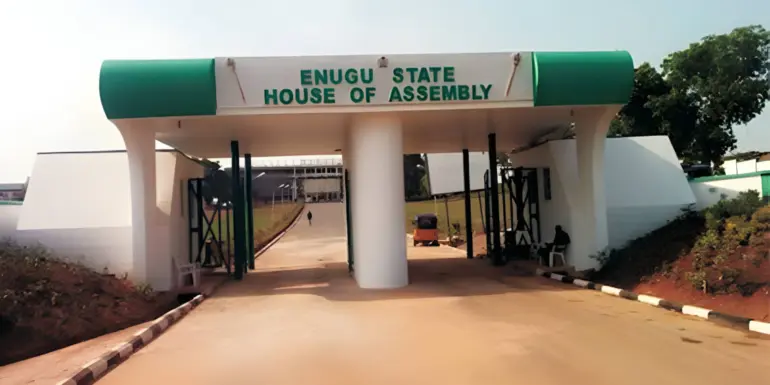
The Enugu State House of Assembly on Tuesday passed a bill seeking to regulate rent increases and reform tenancy laws across the state, proposing a two per cent cap on subsequent rent hikes.
The bill, titled A Bill for a Law to Amend the Landlord and Tenant Second Amendment Bill, Cap. 101, Revised Laws of Enugu State 2024 (House Bill No. 3, 2025), scaled its third reading following the adoption of a joint review report during plenary.
Under the proposed legislation, landlords would be prohibited from increasing rent within the first four years of a tenancy, while subsequent increases would be limited to two per cent of the prevailing rent.
However, the bill provides for an exception where landlords undertake verifiable and substantial renovations, allowing them to increase rent by a maximum of 10 per cent.
The passage followed a motion moved by the member representing Nkanu West Constituency, Hon. Iloabuchi Abugu, and seconded by the Deputy Speaker and member representing Awgu North Constituency, Rt. Hon. Jane Eneh.
The House subsequently dissolved into the Committee of the Whole for a clause-by-clause consideration of the bill.
Presenting the joint report of the House Committees on Housing and Investment, Public Petitions, Ethics and Privileges, and Judiciary, the Chairman of the review committee, Rt. Hon. Okey Mbah, who represents Nkanu East Constituency, said the proposed legislation was the outcome of extensive consultations with relevant stakeholders.
Mbah described the bill as a game-changer aimed at curbing arbitrary rent increases and protecting residents from exploitation by landlords and estate agents.
“This bill will subsidise over 60 per cent of what residents used to pay while trying to secure accommodation,” the lawmaker said.
In his remarks after the passage, the Speaker of the Assembly, Rt. Hon. Uche Ugwu, described the legislation as a significant milestone in the state’s good governance agenda, expressing optimism that it would ease the accommodation challenges facing residents.
“This law is going to address all the cries of residents about the escalating rent in the state,” he said.
The bill, which passed its second reading on March 11, 2026, and underwent a public hearing on March 26, 2026, now awaits the assent of Governor Peter Mbah before it can become law.
The legislative move comes amid growing complaints from residents of Enugu metropolis and surrounding urban centres over rising rents, arbitrary agency commissions and high legal fees, which have made decent accommodation increasingly unaffordable for low- and middle-income earners.

However, the proposed rent restrictions have drawn criticism from some property owners, who argue that the fixed limits fail to reflect prevailing economic realities, including inflation and rising costs of building materials and property maintenance.
A landlord in the state capital, Mr Onyekwere Johnson, described the proposed two per cent rent increase cap as unrealistic and difficult to enforce under the current economic conditions.
Speaking with our correspondent, Johnson argued that landlords should not be subjected to rent restrictions while other sectors of the economy continued to grapple with rising operational costs.
“That would have been a natural law if the prices of petroleum products and electricity tariffs increased by two per cent. Otherwise, it is an unnatural law. It is neither sustainable nor can it be obeyed.
“You cannot single out landlords and regulate their business while other sectors are struggling to meet the benchmark of inflation set by the managers of the Nigerian economy. It violates landlords’ rights against discrimination,” he said.