

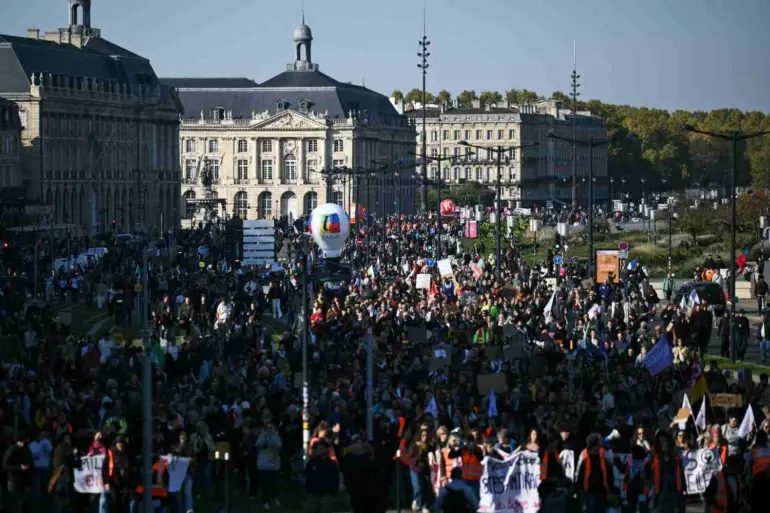
Workers and students took to the streets across France on Thursday to protest rising living costs, social inequality and poor working conditions, as nationwide demonstrations intensified following weeks of unrest.
More than 250,000 people had participated in demonstrations across 73 cities by Thursday afternoon, according to the country’s major labour union, the General Confederation of Labour (CGT).
The protests come as the eurozone’s second-largest economy grapples with mounting financial challenges, barely six months before elections to replace centrist President Emmanuel Macron, with the far right leading in opinion polls.
The demonstrations, initially driven by high school students protesting poor learning conditions, have merged with growing public anger over the rising cost of living and widening inequality. The discontent culminated on October 17 in some of the worst riots France has witnessed in recent years.
Among those participating in Thursday’s demonstrations were Sylvie Larneury, 61, a healthcare manager, and her partner, an IT specialist, who both went on strike to join the march in the central city of Clermont-Ferrand.
“We’re fed up. We’re not starving, but we have to help our children even though they’ve studied,” Larneury said.
“We’ve had enough of social injustice,” she added, criticising what she described as “a repressive government that defends its own interests and not those of the majority”.
The unions are demanding general wage increases, tax reforms and improved learning conditions for young people. They have also criticised police restrictions imposed on some demonstrations.
In Lyon, winegrower Martin Thiberge joined the protest, saying the demonstrations provided an opportunity for people from different backgrounds to unite around common economic concerns.
“We want to make a living from our work, to make a dignified wage,” he said.
In Paris, up to 80,000 people were expected to participate in a march scheduled to begin at 2:00 pm (1300 GMT).
The planned demonstrations also prompted the closure of the Eiffel Tower for the day, according to a notice published on the monument’s official website.
School blockades disrupt classes
Student-led protests also spread across several cities, with the government reporting blockades at 81 of France’s approximately 3,700 high schools.
However, a high school student association said classes had been suspended at about 1,000 secondary schools, including institutions affected by blockades and those closed because of the strike.
The Education Ministry estimated that approximately 16 per cent of teachers nationwide participated in the industrial action.
In Paris, police fired tear gas to prevent students from blocking access to the Helene-Boucher high school, according to an AFP reporter at the scene.
Public and private education unions joined the strike, alongside labour organisations representing railway workers, public hospital employees and postal workers.
The industrial action also threatened to disrupt public transport, with some passengers reporting delays and cancellations.
At Montparnasse railway station in Paris, a psychologist who identified herself as Jeanne said her journey had been delayed by the disruption.
“It’s tedious to get up early, wait, and then see your train cancelled, but it’s understandable there’s a strike,” she said.

Police deploy 70,000 officers nationwide
Meanwhile, Interior Minister Laurent Nunez announced on Wednesday that 70,000 police officers and security personnel would be deployed across the country to maintain order.
He promised “an extremely firm response” to any acts of violence or public disorder during the demonstrations.
Although most protests have remained peaceful, some have degenerated into clashes between demonstrators and security forces, prompting the use of tear gas and water cannon to disperse crowds.
An attempted murder investigation was also launched after petrol bombs were thrown at security personnel in Paris on Saturday.
However, the police response has attracted criticism, with allegations of excessive force and brutality against demonstrators prompting internal investigations.
Several teenage protesters have reportedly sustained serious injuries, while thousands of people have been arrested.
The unrest in France comes amid a wider wave of youth-led demonstrations across Europe, with similar protests reported in Denmark, Germany and Italy in recent weeks.
AFP