

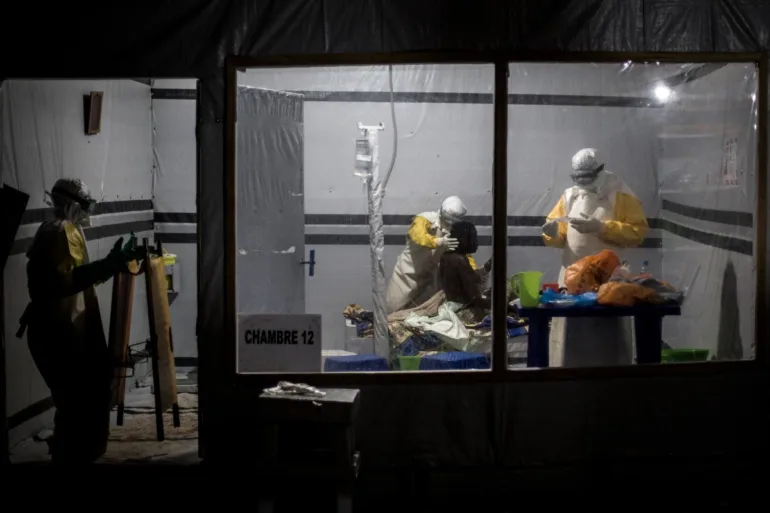
All 62 contacts identified following Nigeria’s confirmation of an imported Ebola case are expected to complete their monitoring by November 13, 2026, as health authorities intensify surveillance and other containment measures to prevent further spread of the disease.
The Nigeria Centre for Disease Control and Prevention (NCDC) disclosed this in its latest Ebola Disease Situation Report obtained by The Telegraph on Monday.
Nigeria confirmed its first case of Ebola disease in the current outbreak on October 20, 2026, after laboratory tests detected the Bundibugyo virus in a woman who had travelled to the country from Uganda.
Although the NCDC did not provide a breakdown of the contacts according to their individual monitoring completion dates, it noted that follow-up was scheduled to end at different times between October 31 and November 13.
According to the report, “Sixty-Two (62) contacts” had been identified, adding that “Contacts are expected to complete follow-up by November. Expected completion dates range from 31 Oct to 13 Nov 2026.”
The November 13 deadline represents the latest projected date for completing the monitoring of all contacts currently identified in connection with the confirmed case. However, surveillance and contact-tracing activities remain ongoing.
The agency said contact tracing and monitoring were continuing, while additional contact tracers had been mapped and trained to strengthen surveillance.
It also disclosed plans to “engage and assess additional contacts for possible evacuation to the quarantine facility” and “continue follow-up of contacts in quarantine.”
In addition, the NCDC said a high-level stakeholder meeting had been held with partner agencies to strengthen coordination, resource mobilisation and accountability in the response.
Among its next steps, the agency listed continued coordination across One Health sectors and partners, implementation of the Incident Action Plan and strengthened preparedness in states considered at high risk.
Ebola testing and laboratory investigations
On laboratory investigations, the NCDC disclosed that 18 samples had been tested since the outbreak was confirmed, with one positive result and 17 negative results.
The positive sample was from the index case, while the 17 negative samples comprised 15 collected from contacts of the confirmed patient and two from suspected cases.
The report stated, “Laboratory confirmation reported on 20th October 2026,” adding that “Phylogenetic sequencing concluded by NCDC NRL & The African Centre of Excellence for Genomics of Infectious Diseases (ACEGID).”
The agency also said the scope and strategy for identifying contacts had been reviewed and expanded, while Ebola disease case definitions had been updated to improve the identification and management of suspected infections.
It further outlined plans to review guidelines on contact tracing, self-quarantine, self-care kits and the Ebola call protocol.
The NCDC also plans to develop an Ebola disease dashboard on the Surveillance Outbreak Response Management and Analysis System (SORMAS) to improve contact management and monitoring.
NCDC strengthens national response coordination
On coordination, the agency said the National Incident Management System had been activated under the leadership of the Coordinating Minister of Health and Social Welfare, Professor Muhammad Ali Pate.
It noted that the implementation of prioritised response activities had continued across thematic areas, while the Incident Action Plan had been finalised.
The NCDC also disclosed that standard operating procedures and job aids had been validated for sample reception, molecular detection and genomic sequencing.
To sustain laboratory capacity, the agency said it would maintain uninterrupted Ebola testing and confirmation at the National Reference Laboratory, with plans to expand testing capacity to Lagos.
Other planned activities include maintaining diagnostic testing and laboratory records, sharing reports of genomic sequencing conducted on the confirmed case sample, and pre-positioning additional laboratory reagents and commodities across the national network of laboratories.
Isolation facilities and case management
The report also noted that an inspection and assessment of the isolation centre had been conducted, while the medical evacuation of the index case had been supervised with measures put in place to protect healthcare workers.
Among its planned activities, the NCDC said it would review and disseminate approved procedures and guidelines covering triage, isolation, supportive care, psychosocial support and discharge.
It also plans to establish referral mechanisms for suspected cases, from the point of detection to designated treatment centres, while identifying and optimising treatment facilities in states with designated points of entry.
On case management, the agency disclosed that it had further engaged the University of Abuja Teaching Hospital on its readiness to serve as an isolation and treatment centre.

It said a needs assessment and optimisation of the hospital had been concluded, while the Federal Capital Territory (FCT) team had been engaged on clinical care and psychosocial support for contacts in quarantine facilities.
The NCDC added that it had secured a dedicated ambulance and placed it on standby to facilitate safe patient referrals.
Infection prevention and control measures
On infection prevention and control, the report disclosed that needs assessments had been conducted across states and health facilities, while healthcare workers were being sensitised on appropriate preventive measures.
The agency said it had also engaged the facility managing the index case on compliance with infection prevention and control guidelines, including standard and transmission-based precautions.
Other response activities included refresher training for environmental health officers and terminal cleaning at the residence of the index case.
The NCDC further plans to implement an infection prevention and control ring strategy across concentric perimeters to strengthen screening and isolation measures.
It also listed plans to assess surge capacity for isolation at Karu General Hospital in the FCT.
How Nigeria confirmed its Ebola case
According to the World Health Organisation (WHO), the patient developed symptoms on October 7, four days after arriving in Nigeria, and sought medical attention at a private health facility in Abuja on October 11.
Laboratory confirmation on October 20 made Nigeria the fifth country to detect the virus since the outbreak was declared in the Democratic Republic of the Congo on May 15, 2026.
The index patient was subsequently evacuated to Switzerland on October 26 for further medical care, alongside her husband, who was identified as a close contact.