

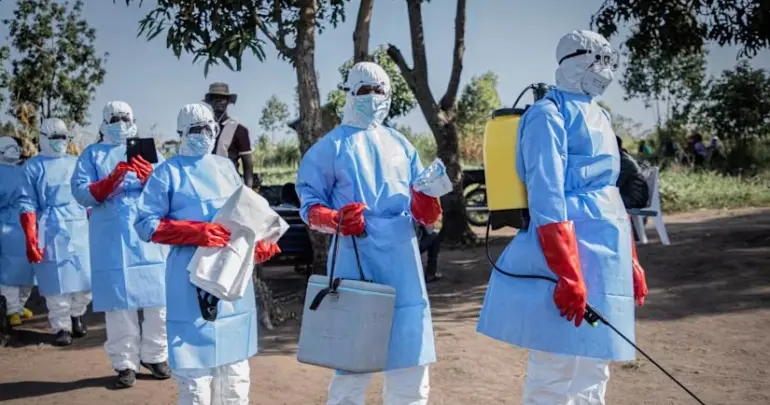
The Ebola outbreak in northeastern Democratic Republic of Congo is spreading into new areas, the World Health Organization (WHO) warned on Friday, raising concerns that containment efforts are lagging behind the pace of transmission.
The WHO said significantly more needs to be done to bring the outbreak under control, noting that available isolation bed capacity remains far below projected requirements based on the current spread.
Since the outbreak was declared on May 15, the WHO reported 676 confirmed Ebola cases and 136 deaths in the DRC. A further 119 cases are suspected, while 32 patients have recovered.
Health authorities say the outbreak is being driven by the rare Bundibugyo species of the virus, for which no approved vaccines or treatments currently exist. The outbreak is centred in Ituri province, with cases also recorded in North Kivu and South Kivu.
“The outbreak continues to expand both in terms of case numbers but also in terms of geographic spread,” said Olivier le Polain, WHO’s head of epidemiology and analytics for response.
Speaking from Beni in North Kivu, he said new cases were being detected almost daily across additional health zones in the three affected provinces, reflecting both the scale of the outbreak and the high mobility of the population.
He noted that while earlier cases in new areas could be linked to travel from known hotspots, there is now evidence of local community transmission in previously unaffected locations.
“There are still many blind spots in some areas that are high risk,” he said, adding that the full extent of the outbreak remains unclear and will become more apparent as surveillance improves.
On contact tracing, le Polain said progress had been made but coverage remained insufficient.
“We are now at just over 70 percent in terms of contacts that are being appropriately traced. That’s a huge improvement from where we were about a week or two ago, but it’s still too low to ensure appropriate control,” he said.
He also warned that isolation capacity is under severe strain. With around 250 isolation beds available across affected provinces, he said current capacity would not be sufficient if trends continue and must be expanded urgently.

“There’s a lot more that needs to be done across the board: more supplies to ensure that we’ve got safe spaces to isolate patients,” he said.
The outbreak has also crossed into neighbouring Uganda, where 19 confirmed cases, including two deaths, have been reported. However, the African Union’s health agency said on Thursday that the situation in Uganda is currently “under control.”
AFP
