

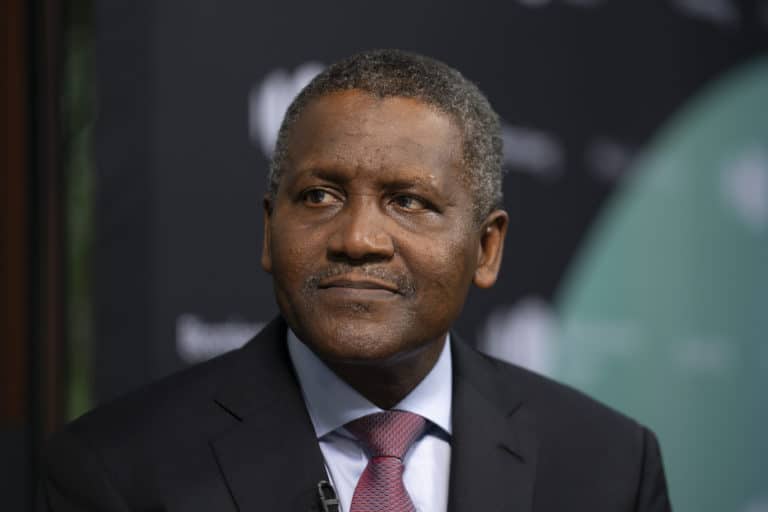
Aliko Dangote, President of the Dangote Group, said on Wednesday that the company rejected requests by the Nigerian National Petroleum Company (NNPC) Limited to increase its stake in the Dangote Petroleum Refinery.
Speaking in an interview with Nicolai Tangen, chief executive officer of the Norwegian Sovereign Wealth Fund, and monitored by The Telegraph, Dangote said the decision was driven by plans to list the refinery publicly and broaden ownership to more Nigerian investors.
He explained that while the NNPC already holds a 7.25 per cent stake, the company sought to acquire additional shares, an offer the group declined.
“The other biggest risk is government policy inconsistency. We are addressing that. If you look at our refinery, the national oil company already owns 7.25 per cent, and they are trying to buy more. We are the ones that said no; we want to spread it and have everybody be part of it,” Dangote said.
In 2021, NNPC acquired a 7.25 per cent stake in the refinery for $1bn, with an option to increase its holding to 20 per cent by June 2024. However, Dangote disclosed that the company ultimately retained only the 7.25 per cent stake after failing to complete the additional payment within the agreed timeline.
He added that the refinery project was financed through a mix of internal resources and support from local and international lenders, including Afreximbank, the Africa Finance Corporation, Zenith Bank, Access Bank, UBA, Standard Bank of South Africa, and Standard Chartered Bank.
“We initially planned to fund most of the project internally, but due to naira devaluation, we had to rely on financing from these institutions,” he said.
Refinery output hits 661,000 barrels per day
Dangote also revealed that the refinery is now operating at 661,000 barrels per day, above its 650,000 bpd installed capacity, adding that the milestone demonstrates the facility’s operational strength.
He said the performance has strengthened investor confidence in the group.
“The refinery has been tested. We have processed up to 661,000 barrels a day. That shows capability. Now financial institutions are more willing to back us because they know we can deliver,” he said.
Impact of global conflicts and commodity prices
Commenting on global economic conditions, Dangote said recent geopolitical tensions had unexpectedly boosted parts of his business, particularly fertiliser and petrochemicals, due to rising global prices.
He noted that fertiliser prices had risen from about $400 per tonne in February to around $850, while polypropylene increased from roughly $900 to about $3,000.
“In some ways, the impact of the war has been more beneficial to our business than negative. Demand for fertiliser is very strong, and we are oversold,” he said.
He also said aviation fuel output from the refinery was fully booked for weeks ahead, while daily jet fuel production stands at about 20 million litres.
On crude sourcing, Dangote said the refinery currently sources about 56 per cent of its crude from Nigeria, with additional supplies from Angola, Libya, and the United States.
“We now buy about 21 cargoes every month. We are expanding, and in the next 30 months we expect to reach 1.4 million barrels per day,” he said.
‘Mafia’ opposition and subsidy claims
Dangote also alleged that entrenched interests were opposed to the refinery’s operations, claiming that some beneficiaries of the previous fuel subsidy regime and trading networks were resisting change.
He said the removal of fuel subsidies had disrupted long-standing profit structures in the oil sector.
Expansion plans and valuation targets
Looking ahead, Dangote said the group plans to raise about $45bn in additional investment and scale revenue toward $100bn by 2030.
He also projected that EBITDA could grow from about $3bn last year to over $30bn by the end of the decade, with cement production targeted to reach 100 million tonnes.
Personal remarks
Dangote also disclosed that he sold his properties in the United States and United Kingdom to fully base himself in Nigeria and focus on his businesses.
“I wanted to concentrate in Nigeria. Wherever I go now, I stay in hotels. It keeps me focused,” he said.
He added that his business strategy is driven by identifying essential needs and producing locally through backward integration, aimed at reducing imports and strengthening domestic production.
