

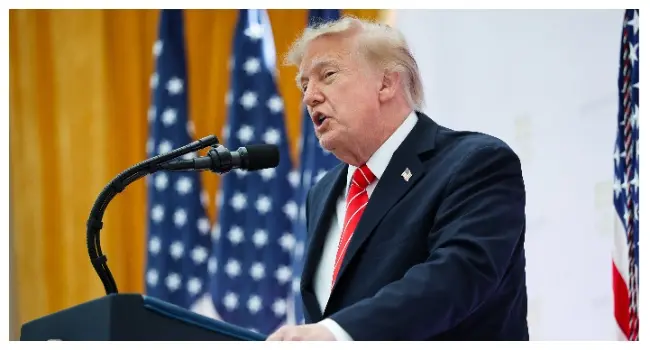
US President Donald Trump has claimed that American forces have destroyed much of Iran’s military and nuclear capabilities, warning that one or two remaining targets could still be hit as tensions between Washington and Tehran threaten to escalate.
Speaking to reporters at his Florida residence on Saturday, Trump said negotiations aimed at ending the war, which began with US and Israeli strikes against Iran in February, were progressing but expressed doubts about Tehran’s reliability.
“We’ve knocked out their nuclear. We still have to take care of, I would say one or two sites, but we can do that in 10 minutes,” Trump said.
“You probably could look at Pickaxe Mountain, and you have to take care of that. We can do that all very quickly,” he added, referring to a suspected underground nuclear facility.
Iranian authorities have denied that any nuclear activities are being conducted at the site.
Trump maintained that Washington was in no hurry to launch further offensive operations, insisting that Iran’s military and nuclear programmes had already suffered devastating damage.
Earlier on Saturday, US Secretary of State Marco Rubio said Trump had yet to decide whether to authorise fresh strikes against Iran, stressing that Washington remained open to a diplomatic solution.
Meanwhile, Iran’s Supreme Leader, Mojtaba Khamenei, warned the United States and Israel against resuming military operations, following threats from both countries that further attacks remained possible after crucial elections.
Trump had previously suggested that another attack could take place after the US midterm elections, while Israeli Prime Minister Benjamin Netanyahu described the current situation as a “historic, one-time opportunity” to topple the Iranian government.
The political developments in both countries could influence the future direction of the conflict. Israel held its general election on Tuesday, but efforts to form a new government remain ongoing.
In a statement released on Saturday, Khamenei warned that any further threat against Iran would trigger an immediate and widespread response.
“Any level or type of threat must be met with an immediate, impactful and geographically unrestricted response,” he told senior military commanders, according to the statement.
He also instructed military chiefs to expand Iran’s target list to include “all types of tangible and intangible assets belonging to the American-Zionist enemy”.
The meeting marked the first reported encounter between Khamenei and senior military commanders since he assumed the leadership in March, following the death of his father, Ayatollah Ali Khamenei, in US-Israeli strikes.
The new supreme leader has not appeared publicly since before taking over the position.
Oil prices surge as Hormuz blockade deepens
Rubio warned that Washington retained the military capability to achieve its objectives in Iran but reiterated that Trump had not made a decision on further attacks.
“We can achieve military objectives if we seek to,” he said.
Meanwhile, Iran’s restrictions on shipping through the Strait of Hormuz have heightened concerns over global energy supplies. The strategic waterway normally handles approximately one-fifth of the world’s oil consumption.
Tehran has also previously threatened to disrupt undersea communication cables running through the strait.
Iranian state television reported on Saturday that a vessel travelling through the waterway had struck a mine and caught fire.
The Islamic Revolutionary Guard Corps (IRGC) had also announced on Friday that three oil tankers were halted following unspecified incidents or suspected mine strikes.
The restrictions have driven up global energy prices, adding to economic concerns in the United States ahead of the midterm elections.
The rising cost of energy has also become a political challenge for Trump, with potential gains by opposition Democrats in the elections threatening to limit his ability to advance key policy priorities.
In Israel, Netanyahu’s political camp secured the largest number of parliamentary seats but fell short of an outright majority, leaving the composition of the next government uncertain.
Diplomatic push to prevent renewed fighting
Fresh diplomatic efforts are underway to prevent a resumption of hostilities, with Qatar and Pakistan continuing to mediate between Washington and Tehran.
Qatari mediators arrived in Tehran on Friday, while US Vice President JD Vance reportedly sent a letter to Iran’s security chief, Mohsen Rezaei.
Rezaei, who heads Iran’s Supreme National Security Council, confirmed receiving the correspondence in a video broadcast on Iranian television.
“I read the letter,” he said.
“I haven’t yet responded. Their tone has completely changed,” he added, describing the shift as “a good sign” without providing further details.
However, Iranian Foreign Minister Abbas Araghchi said there were currently no plans for direct meetings with American officials.
“Iran’s conditions are clear, and consultations regarding them are ongoing among mediators,” he said in an interview with Al Jazeera, according to the state news agency IRNA.
Rezaei also insisted that Iran would maintain its blockade of the Strait of Hormuz until its demands, including the release of frozen Iranian assets, were met.
Despite ongoing mediation efforts by Qatar and Pakistan, negotiations have yet to produce a lasting agreement.
Iranian army spokesman Mohammad Akraminia warned that any renewed military confrontation would widen the conflict beyond its current geographical boundaries.
“The flames of war will undoubtedly engulf a much wider geographical area,” he said in a social media post.
Araghchi also issued a fresh warning on X, declaring that there would no longer be any “red lines” in the event of further attacks.
AFP