

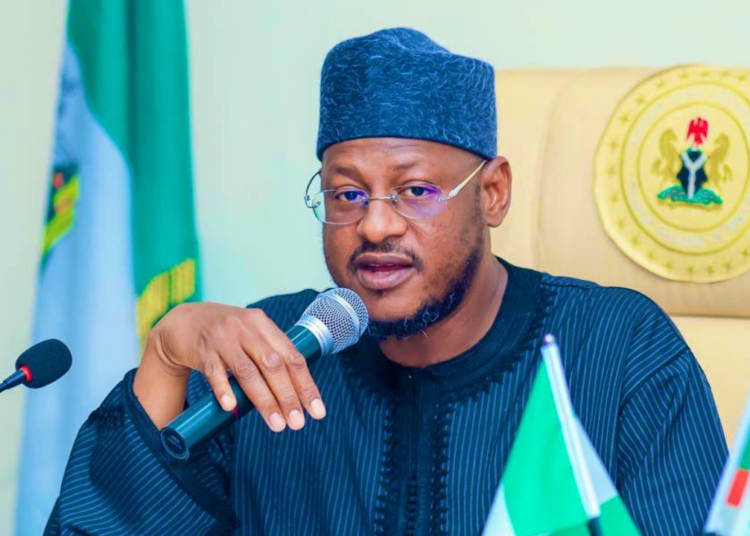
Katsina State Governor, Dikko Radda, on Tuesday presented a proposed ₦828.64 billion 2027 budget to the state House of Assembly for consideration and passage, with nearly 77 per cent of the spending plan earmarked for capital projects.
The appropriation bill, tagged “Building Your Future IV”, allocates ₦637.91 billion, representing 76.98 per cent, to capital expenditure, while ₦190.73 billion, or 23.02 per cent, is set aside for recurrent expenditure.
The proposed budget is ₦69.23 billion lower than the approved 2026 budget, reflecting what the governor described as a more realistic assessment of the state’s revenue and expenditure outlook.
Presenting the bill before lawmakers, Radda said the government adopted a “pragmatic, disciplined and realistic” approach in preparing the fiscal plan. He said ministries, departments and agencies were required to justify their spending proposals based on available resources and the administration’s development blueprint.
“We took a pragmatic, disciplined and realistic view of both revenue and expenditure. We reviewed every available funding source to ensure fiscal balance, strengthen implementation and reduce the risk of shortfalls,” the governor said.
Radda said the 2027 budget was also shaped by citizens’ demands following a budget consultation exercise conducted across the state’s 361 wards.
He said each ward would receive a special project selected by residents, while data gathered during the exercise would guide interventions in agriculture, small businesses, water and sanitation, women’s empowerment, environmental protection and security.
“Our people named their needs, weighed them and ranked them. This budget therefore answers the real and pressing needs of our communities, not assumptions made from afar,” he said.
The Social Sector received the largest allocation of ₦317.73 billion, representing 38.34 per cent of the budget, followed by the Economic Sector with ₦303.17 billion, or 36.59 per cent. The Administration Sector was allocated ₦198.55 billion, while ₦9.19 billion went to the Law and Justice Sector.
Five priority areas will jointly receive ₦325.45 billion from the capital budget. Basic and Higher Education takes ₦83.82 billion, Works and Housing ₦71.60 billion, Agriculture and Livestock ₦65.88 billion, Health ₦53.64 billion, and Rural Development ₦50.51 billion.
The governor said the allocations were designed to strengthen education infrastructure, improve healthcare delivery, expand agricultural production, develop roads and housing, and improve infrastructure in rural communities.
2026 budget implementation
Reviewing the implementation of the 2026 budget, Radda said the state had recorded progress in education, healthcare, agriculture, infrastructure and security.
As of August 28, total expenditure stood at ₦295.19 billion, representing 32.88 per cent of the approved budget, while capital expenditure reached ₦193.02 billion.
He expressed confidence that implementation would accelerate in the remaining months of the year as ongoing projects reached completion.
“We expect this figure to close much higher in our third and fourth quarterly reports for 2026,” he said.
Radda highlighted major investments in education, including ₦13.03 billion for school rehabilitation under the TESS programme, ₦10.53 billion under AGILE and ₦5.88 billion for primary school interventions through UBEC. The government also committed ₦2.07 billion to examination fees and ₦1.26 billion to scholarships.
In healthcare, he said ₦4.71 billion had been spent on the State Emergency Medical Service and Ambulance System Programme.
He added that more than ₦9.59 billion had been invested since 2025 in equipping the Medical Imaging Centre at the General Amadi Rimi Specialist Hospital in Katsina, as part of efforts to convert the facility into a cancer and imaging centre.
The governor said the government had also committed ₦21.43 billion to fertiliser procurement and spent ₦3.11 billion on rural access roads to facilitate the movement of agricultural produce.
On security, Radda disclosed that more than ₦7.5 billion had been spent on security assets, allowances and operations in 2026.
He acknowledged continuing security challenges in frontline communities but said improved security had enabled some farmers to return to their fields.
Radda also identified inadequate staffing and learning materials, pressure on healthcare services, shortages of potable water, poor sanitation and infrastructure deficits as key challenges confronting the state.
He commended the Speaker of the Assembly, Nasir Yahaya Daura, and lawmakers for what he described as a constructive relationship between the executive and legislature.
“The constructive relationship between the Executive and the Legislature remains vital to good governance,” he said, urging lawmakers to consider and pass the 2027 Appropriation Bill in good time.
Assembly commends Radda
Responding, the Speaker of the Katsina State House of Assembly, Nasir Daura, praised the Radda administration for its development efforts and cordial relationship with the Assembly, particularly in infrastructure, security, education, healthcare, agriculture and human capital development.
Daura said the 8th Assembly had passed more than 50 bills and pledged to swiftly consider and pass the governor’s 2027 budget proposal.
He also declared the Assembly’s support for Radda’s second-term bid, as well as President Bola Tinubu and other APC candidates in the 2027 elections.
Daura noted that the budget presentation marked his final appearance as Speaker, expressing gratitude for his tenure and indicating plans to seek a seat in another legislative chamber.
“Your Excellency, permit me to make a personal remark. This will be the last time I will receive you in this capacity as Speaker of the 8th Katsina State House of Assembly, as I look forward, by the grace of Allah, to serving our people in another chamber.
“I am deeply grateful to Almighty Allah for the privilege of serving under your administration as the Speaker of the 8th Assembly,” Daura said.
