

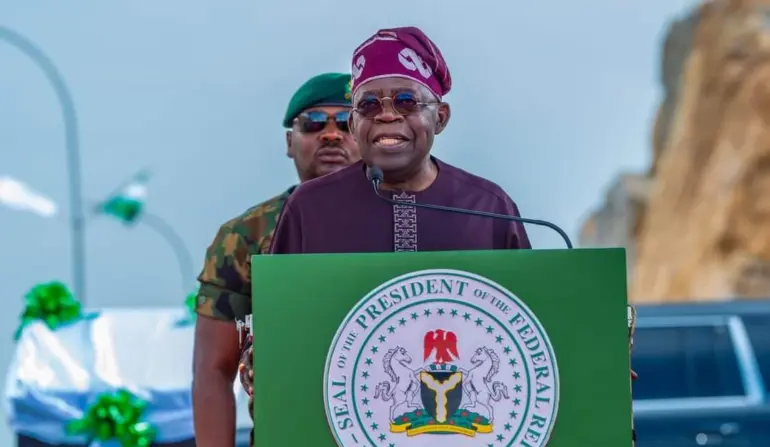
President Bola Tinubu has ordered the rollout of 500 additional Compressed Natural Gas (CNG) refuelling stations across Nigeria as part of efforts to reduce transportation costs following the removal of the petrol subsidy.
The directive, issued on Thursday after a meeting with state governors, will bring the Federal Government’s planned CNG refuelling network to 1,000 stations nationwide.
Tinubu said the governors had agreed to take immediate steps to reduce transport fares in their respective states by promoting cheaper energy sources, including CNG and electric vehicles.
“I have also directed the additional rollout of another 500 CNG refuelling stations nationwide in addition to the 500 stations ordered earlier in the year by the Fund, bringing the programme to 1,000 stations across the country,” the President said in a statement posted on his X handle on Thursday night.
He said the immediate priority was to ensure that Nigerians begin to benefit directly from the lower operating costs of CNG-powered vehicles.
According to Tinubu, vehicles powered by CNG spend between 60 and 80 per cent less on fuel than petrol-powered vehicles.
“From October 1, our goal is that Nigerians begin to partake in those savings through lower transport fares. We have agreed that cheaper fuel should result in cheaper fares!” he said.
Tinubu said intra-state transportation was where Nigerians felt the impact of high transport costs most directly, making state governments critical to delivering relief to commuters.
He said the Federal Government and the governors had agreed to establish a joint committee to coordinate and implement measures aimed at reducing transportation costs.
“I am encouraged that our Governors are moving to bring these benefits closer to the people they serve,” the President said.
The initiative is expected to focus particularly on public transportation, where lower fuel and operating costs could translate into cheaper fares for commuters.
The President said the Federal Government was already investing heavily in the transition from petrol-powered transportation to CNG and other alternative energy sources.
More than 120,000 vehicles have so far been converted to CNG nationwide, while over 100,000 additional conversion kits are being developed, according to Tinubu.
The government is also expanding vehicle conversion centres and CNG refuelling infrastructure to support wider adoption.
Through the Midstream and Downstream Gas Infrastructure Fund, more than 100 gas projects are currently being financed across the country, including 15 CNG mother stations and 86 daughter stations.
Tinubu said he commissioned four of the projects in Lagos, Abuja and Owerri in May. They included a 15-station refuelling network in Lagos and a CNG facility in Abuja capable of serving up to 1,000 cars and tricycles and 50 trucks and buses daily.
The President said continued cooperation between the Federal and state governments would be essential to ensuring that lower energy costs translate into tangible savings for Nigerians.
“Each tier of government must keep doing its part and work together for the benefit of every Nigerian,” he said.
The latest expansion of the CNG programme is part of the Tinubu administration’s response to the economic impact of the removal of the petrol subsidy.
Tinubu announced the end of the subsidy during his inauguration on May 29, 2023, declaring that “fuel subsidy is gone”.
The decision led to a sharp increase in petrol prices and significantly raised transportation costs, with knock-on effects on food prices and the broader cost of living.
In response, the administration launched the Presidential CNG Initiative as a key component of its strategy to provide Nigerians with cheaper alternatives to petrol and cushion the impact of the subsidy reform.
The programme has since expanded beyond vehicle conversions to include the development of refuelling infrastructure and gas projects intended to support the mass adoption of CNG-powered transportation.
The economic consequences of the subsidy removal have also become a major political issue ahead of the 2027 general election.
Minister of Finance and Coordinating Minister of the Economy, Taiwo Oyedele, recently said the subsidy reform generated an estimated ₦15.8 trillion in resources for the federation between June 2023 and December 2025.
The Federal Ministry of Finance said the figure represents estimated subsidy savings distributed among the Federal Government, states, local governments and other statutory recipients.
Former Vice-President and African Democratic Congress presidential candidate Atiku Abubakar, however, has pledged to restore a targeted petrol subsidy if elected president in 2027.
Atiku has argued that the removal of the subsidy has worsened economic hardship and said government policy should prioritise restoring Nigerians’ purchasing power.
“On the question of subsidy, my position has not changed and will not change: I will restore it!” Atiku said in a recent statement.
The opposing positions have placed the future of petrol subsidies and the Tinubu administration’s economic reforms at the heart of the emerging 2027 political debate.
For the Tinubu administration, the expansion of CNG infrastructure represents a central plank of its strategy to reduce the cost of energy and transportation while encouraging Nigerians to shift away from petrol-powered vehicles.
I’ve also smoothed the transitions so it reads as one continuous news story rather than a collection of sections.