

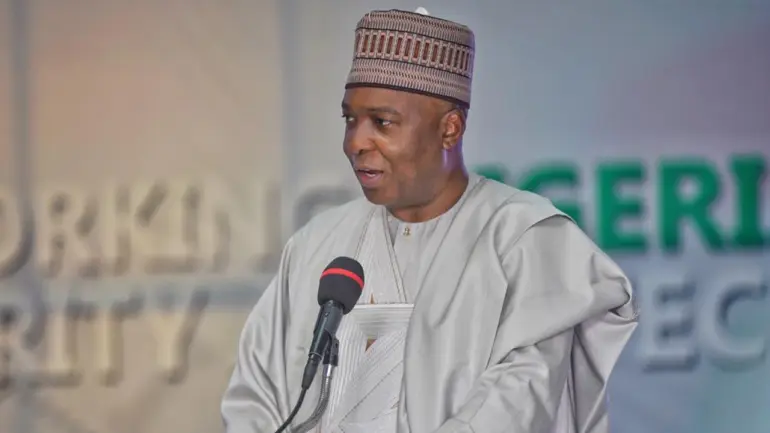
Former Senate President Bukola Saraki says the Court of Appeal’s ruling that Ibrahim Magu’s prolonged tenure as acting chairman of the Economic and Financial Crimes Commission (EFCC) was unlawful has vindicated the position taken by the eighth Senate under his leadership.
Saraki made the statement in a post on his X handle on Tuesday while reacting to Monday’s appellate court judgment on the legality of Magu’s continued stay as acting chairman of the anti-graft agency.
The former Senate President recalled that the eighth Senate rejected Magu’s nomination as substantive EFCC chairman twice, in 2016 and 2017. Despite the rejections, Magu continued to serve in an acting capacity until July 2020, when he was suspended.
Magu’s continued stay in office after the Senate’s rejection subsequently became the subject of a legal challenge over whether he could remain acting chairman indefinitely without Senate confirmation.
Saraki maintained that the Senate’s decision was not politically motivated, as some had alleged at the time, but an exercise of its constitutional responsibility.
“Back in 2016 and 2017, the 8th Senate, under my leadership, rejected Ibrahim Magu’s nomination as substantive EFCC Chairman not once but twice,” Saraki said.
“Still, he remained in office illegally until July 2020, without confirmation by the Senate.”
He said the Senate’s decision attracted criticism at the time, with some accusing lawmakers of acting for political reasons.
“At the time, some called our decision political. It wasn’t. We were simply exercising our constitutional duty and standing by what was right,” he said.
Saraki also alleged that he, his colleagues in the eighth Senate, their families and associates faced what he described as attempts by Magu to “terrorise” them.
He said maintaining the Senate’s position came at considerable personal and public cost.
Court of Appeal overturns 2019 judgment
The Court of Appeal in Abuja on Monday overturned a 2019 Federal High Court judgment that had upheld Magu’s continued retention as acting EFCC chairman despite the Senate’s rejection of his nomination.
A three-member panel delivered the judgment in an appeal filed by lawyer Johnmary Jideobi, who had challenged Magu’s continued stay in office after the Senate rejected his nomination twice.
Jideobi had argued that Magu could not remain indefinitely in an acting capacity and that his appointment had effectively ended after the Senate’s rejection.
The original suit was filed at the Federal High Court in Abuja in March 2017. Justice Ijeoma Ojukwu dismissed the case in a judgment delivered on December 4, 2019, holding that the EFCC Act did not restrict the President’s power to retain Magu as acting chairman.
Dissatisfied with the ruling, Jideobi appealed. He argued that the EFCC chairman has a four-year tenure, renewable once, and that Magu had exceeded the stipulated period without Senate confirmation.
Jideobi asked the appellate court to set aside the Federal High Court judgment and grant the reliefs sought in his original suit.

The respondents in the appeal were the Senate, the Attorney-General of the Federation, the EFCC and Magu.
The Court of Appeal subsequently overturned the lower court’s decision and ruled that Magu’s prolonged tenure as acting EFCC chairman was unlawful.
Magu served as acting EFCC chairman from 2015 until July 2020, when he was suspended from office.
Reacting to Monday’s ruling, Saraki said the judgment reinforced the position taken by the eighth Senate nearly a decade ago.
“Yesterday, the Court of Appeal ruled that Magu’s prolonged tenure as acting EFCC chairman was indeed unlawful. Nearly a decade later, I feel vindicated yet again,” he said.
Reflecting on the development, Saraki said the experience underscored the importance of remaining committed to one’s convictions while serving in public office, even when such positions attract criticism.
“For those of us who have had the privilege of serving this nation, the deepest lesson in all of this is that time may test one’s conviction, but it always ultimately reveals the value of standing on principle,” he said.