

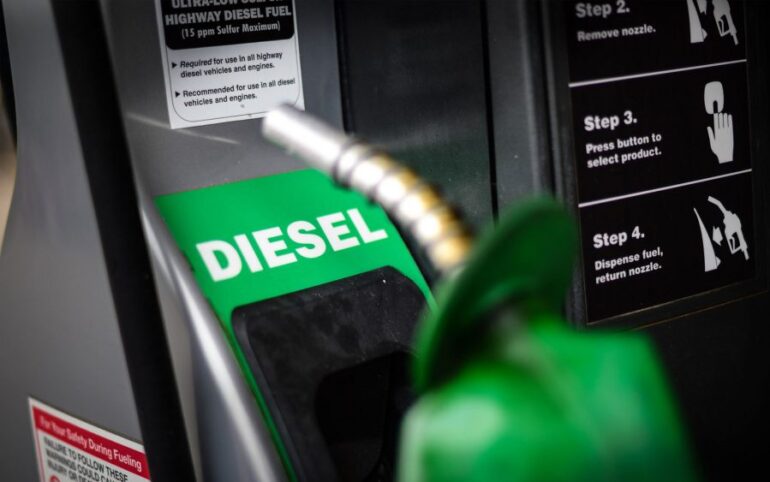
Nigerians continued to grapple with high energy costs in May as the prices of the country’s three major transport and household fuels remained significantly above year-earlier levels, with diesel recording the sharpest increase despite mixed monthly movements.
The latest Price Watch report released by the National Bureau of Statistics (NBS) showed that the average retail price of Automotive Gas Oil (diesel) rose by 86.4 per cent year-on-year to ₦3,277.47 per litre in May 2026 from ₦1,758.26 in the corresponding month of 2025.
Diesel also recorded the steepest monthly increase among the three fuels, climbing 32.44 per cent from ₦2,474.69 in April.
The surge remains significant because diesel is widely used by manufacturers, commercial transport operators, industries and businesses that depend on self-generated electricity, making it a major cost driver across the economy.
Premium Motor Spirit (PMS), popularly known as petrol, also maintained its upward trend, with the average retail price rising to ₦1,596.25 per litre in May from ₦1,027.76 a year earlier, representing an annual increase of 55.31 per cent.
On a month-on-month basis, however, petrol prices rose at a more moderate pace of 4.13 per cent from ₦1,532.93 recorded in April.
Household kerosene, which remains an important cooking fuel for many Nigerians despite the increasing adoption of Liquefied Petroleum Gas (LPG), recorded the smallest annual increase among the three products.
The average retail price stood at ₦2,971.94 per litre in May, up 36.62 per cent from ₦2,175.29 in the same period last year.
Unlike diesel and petrol, kerosene prices edged lower on a monthly basis, with the average retail price per litre declining marginally by 0.17 per cent from ₦2,976.94 in April.
The average retail price per gallon of household kerosene also fell by 10.8 per cent month-on-month to ₦11,949.39 from ₦13,396.23, although it remained 40.88 per cent higher than the ₦8,482.22 recorded in May 2025.
Overall, the NBS data showed that while kerosene prices showed signs of easing in the short term, households and businesses continued to pay substantially more for fuel than they did a year earlier, underscoring the persistence of energy inflation across the economy.
State-by-state data revealed significant disparities in fuel prices across the country.
For diesel, Nasarawa recorded the highest average retail price at ₦3,785.84 per litre, followed by Plateau (₦3,576.40) and Ebonyi (₦3,574.75). Kogi recorded the lowest average price at ₦2,823.85, ahead of Benue (₦2,961.33) and Kebbi (₦3,016.14).

Petrol was most expensive in Edo, where consumers paid an average of ₦1,722.91 per litre. Bauchi followed at ₦1,715.47, while Benue recorded ₦1,698.57. Adamawa posted the lowest average price at ₦1,469.83, followed by Katsina (₦1,470.63) and Sokoto (₦1,489.33).
Household kerosene was costliest in Sokoto at ₦3,984.09 per litre, followed by Jigawa (₦3,824.68) and Taraba (₦3,595.64). Bayelsa recorded the lowest average price at ₦2,018.79, ahead of Kogi (₦2,348.81) and Ekiti (₦2,511.31).
Across the geopolitical zones, the North-West recorded the highest average diesel price at ₦3,313.60 per litre, while the South-West had the lowest zonal average at ₦3,227.55.
For petrol, the South-South recorded the highest average retail price at ₦1,623.84 per litre, while the North-West posted the lowest at ₦1,564.11.
The North-West also emerged as the most expensive zone for household kerosene, with an average retail price of ₦3,343.12 per litre, followed by the North-East at ₦3,004.30. The South-South recorded the lowest zonal average at ₦2,777.76 per litre.