

Iran launched a new wave of missile and drone attacks across the Middle East on Wednesday, hours after US President Donald Trump signalled tentative progress in efforts to end the escalating conflict.
The war, which began on February 28 with joint US-Israeli strikes on Iran, has rapidly expanded across the region, disrupting global energy markets and raising fears of a broader regional crisis.
Iran’s Revolutionary Guards said they fired “precision-guided” missiles and drones targeting Israel, as well as bases hosting US forces in Kuwait, Jordan and Bahrain.
AFP images showed rocket trails streaking across the skies above the Israeli city of Netanya, while air raid sirens sounded across much of the country’s central region.
In Kuwait, drones struck a fuel tank at the international airport, triggering a large fireball. Authorities in Jordan reported falling shrapnel near the capital, Amman, while air raid warnings were also activated in Bahrain.
The widening conflict has shaken Gulf nations, long considered relatively stable in the region, disrupting tourism and severely impacting global air travel as key transit hubs come under threat.
Fighting has also intensified in Lebanon, where Israeli forces have stepped up operations against Iran-backed Hezbollah, pushing towards the Litani River, about 30 kilometres from the border.
In the town of Sahel Alma, north of Beirut, explosions left buildings damaged and streets littered with debris. “We have two-year-old children scared and crying,” a resident, Gaia Khouiri, told AFP.
Lebanese authorities say more than 1,072 people have been killed and over one million displaced since the escalation began. Israeli airstrikes continued overnight in Beirut’s southern suburbs, a Hezbollah stronghold, leaving widespread destruction.
Meanwhile, Israel said it was launching fresh strikes on what it described as “the infrastructure of the Iranian terror regime.”
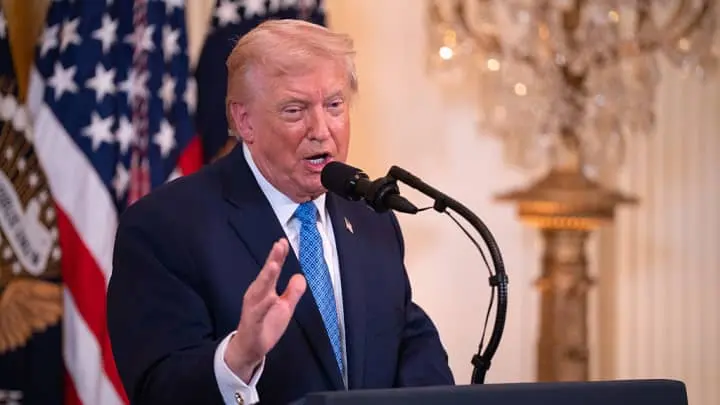
Despite the ongoing violence, diplomatic signals have emerged. Trump said Washington was “in negotiations right now” with Tehran, suggesting possible movement toward de-escalation.
Speaking at the Oval Office, the US president said Iran had offered a “very big present,” which he linked to developments around the Strait of Hormuz, a critical oil shipping route that Tehran has partially blockaded in response to the conflict.
While details remain unclear, reports suggest Washington may have sent a multi-point proposal to Iran via Pakistan, which has offered to mediate. Iran has yet to confirm any formal talks.
At the same time, US media reported plans to deploy an additional 3,000 American troops to the region, underlining the fragile and uncertain state of diplomacy.

Strait of Hormuz in focus
Attention remains fixed on the Strait of Hormuz, through which roughly one-fifth of the world’s oil supply passes.
Iran has signalled it will allow safe passage for “non-hostile” vessels, but warned that ships linked to what it described as “aggressor parties” including the United States and Israel, would be denied access, according to the International Maritime Organization.
The crisis is already reverberating across global markets, prompting countries to cut energy consumption and airlines to scale back operations.
However, Iran’s assurances and signs of diplomatic engagement helped ease market tensions slightly, with stocks rising and oil prices dipping in Asian trading.
A senior World Trade Organization official warned the disruption could have lasting consequences beyond energy markets.
“Fertilisers are the number one issue of concern today,” Jean-Marie Paugam told AFP. “If supply is disrupted, it will affect both production and prices, with impacts that could carry into future harvests.”