

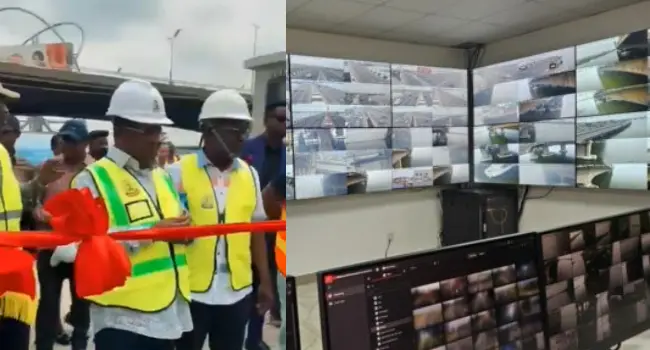
The Federal Government has inaugurated a ₦40 billion closed-circuit television (CCTV) control centre for the Third Mainland Bridge in Lagos, marking a major step in enhancing security and traffic management on the country’s busiest bridge.
Speaking at the inauguration on Sunday, the Minister of Works, David Umahi, said the project followed extensive rehabilitation work carried out on the bridge after the current administration assumed office in 2023.
Umahi explained that the CCTV system, first announced in 2025, was designed to curb dangerous driving, prevent suicide attempts, and strengthen overall security on the bridge.
He said security personnel would monitor live footage from the control centre and enforce speed limits to reduce accidents and other incidents.
“When we came on board in 2023, we met a very terrible Third Mainland Bridge,” the minister said, noting that the structure, alongside the Carter and Iddo bridges, required comprehensive re-evaluation and repairs both above and below water level.
According to him, President Bola Tinubu approved the total rehabilitation of the bridge, including the replacement of expansion joints, which has significantly improved driving conditions and extended the bridge’s lifespan.
Umahi disclosed that the contract also includes a surveillance boat and two Hilux vans, which will be handed over to the police to enhance monitoring and rapid response capabilities.
“The idea is that we can see everything that is happening on the bridge,” he said, expressing concern over excessive speeding and urging motorists to comply with traffic regulations.
Also speaking, the Federal Controller of Works in Lagos, Olufemi Dare, described the facility as the first CCTV control centre of its kind on any bridge in Nigeria.
He said the system enables real-time monitoring of activities on the bridge and its surrounding waters.

According to Dare, the project comprises 240 solar panels, 10 inverters, a 300 kVA transformer, a standby generator, multiple monitoring screens, and a fully air-conditioned control centre.
He added that the contract also covers the installation of 1,268 solar-powered street lights and the provision of a borehole facility.
Dare disclosed that the project was awarded for ₦40.17 billion, with about ₦36 billion already paid to the contractor.
He noted that the inauguration marks the completion of the first phase, with further commissioning planned once work on the bridge’s extension is concluded.