

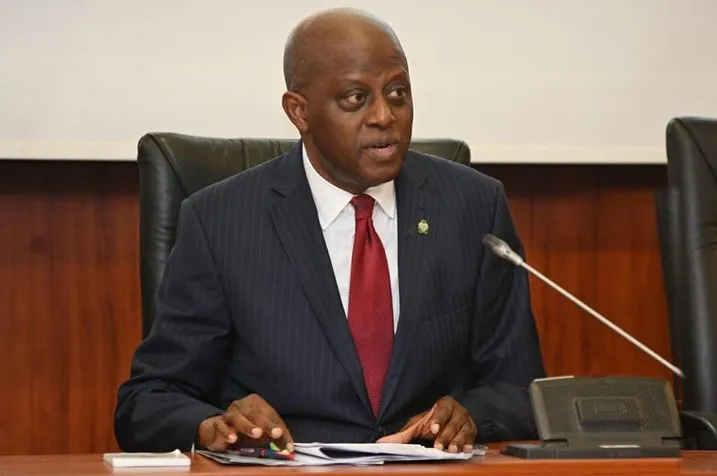
Nigeria has achieved its target of attracting $1 billion in monthly diaspora remittances, the Central Bank of Nigeria (CBN) Governor, Olayemi Cardoso, has announced.
Cardoso disclosed this on Friday at the 61st Annual Bankers’ Dinner organised by the Chartered Institute of Bankers of Nigeria (CIBN) in Lagos, saying the country was now targeting $1.5 billion in monthly remittance inflows by the end of the first half of 2027.
He described the achievement as a significant milestone in the country’s financial reforms, noting that efforts to improve access to foreign exchange and strengthen formal remittance channels had helped restore confidence among Nigerians in the diaspora.
“When I stood before you last year, I spoke of our ambition to increase monthly remittances to $1 billion a month. I am pleased to report that this milestone has been achieved.
“We are now working towards increasing monthly remittances to $1.5 billion by the end of the first half of 2027,” Cardoso said.
The CBN governor also highlighted improvements in international payment services, noting that Nigerians abroad could now make transactions more conveniently using their cards.
He said the reforms had improved the experience of Nigerians travelling or living abroad, who previously faced difficulties making payments and accessing international financial services.
Cardoso commended licensed International Money Transfer Operators (IMTOs) for their contributions to improving transparency, investing in technology and expanding formal remittance channels, particularly across Asia.
Turning to the broader economy, he said the next phase of Nigeria’s financial reforms would focus on deepening market liquidity, broadening participation and expanding the range of financial instruments available to businesses and investors.
He disclosed that the naira had appreciated by approximately six per cent over the past year, while daily foreign exchange market turnover had occasionally exceeded $1 billion.
In the fixed-income market, he said daily turnover averaged N1.5 trillion, supported by a credible and tradable benchmark yield curve extending to 10 years.
According to Cardoso, these developments indicate growing confidence in Nigeria’s financial markets and improved market activity.
He stressed that the priority was to ensure that financial markets continued to support efficient price discovery and effective capital allocation.
Addressing recent movements in the foreign exchange market, the CBN governor said fluctuations in exchange rates were normal in a market-driven system and should not necessarily be interpreted as signs of economic weakness.
He explained that exchange rates naturally respond to changing macroeconomic conditions and developments in the global economy, including shifts in United States interest rates and international investor sentiment.

“Emerging market currencies, including ours, have experienced volatility amidst changes in the United States’ interest rate environment and global risk sentiment.
“Nigeria, as I have said, is part of this interconnected global financial system, but believe me, we are considerably better equipped to manage external shocks than we were three years ago,” he said.
Cardoso added that the country’s strengthened external reserves and other economic buffers had improved its ability to withstand external shocks.
He assured investors that the CBN remained prepared to deploy its reserves when necessary to address disorderly market conditions and minimise the impact of external shocks.
“The recent short-term movements should be viewed in the context of our strengthened macroeconomic fundamentals and the outlook for 2027,” he added.