

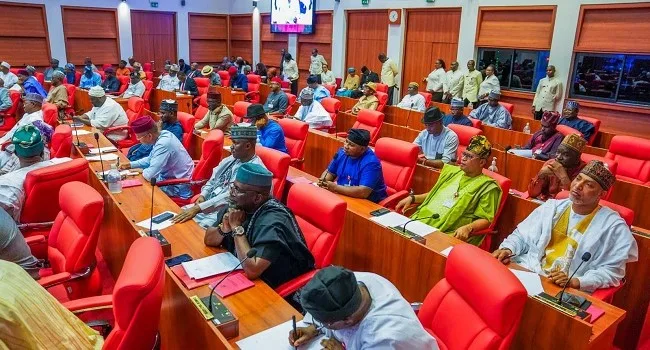
The Senate has defended the passage of the Constitution of the Federal Republic of Nigeria (Alteration) (State Police) Bill, 2026, insisting that the proposed constitutional amendment is a response to the country’s worsening security situation rather than a politically motivated initiative.
In a statement on Sunday, the Directorate of Media and Public Affairs to the Leader of the Senate, Opeyemi Bamidele, described the bill as “a child of necessity and not of political expediency”, saying it emerged from extensive national consultations rather than partisan considerations.
The bill, which seeks to establish state police in Nigeria, was passed by the House of Representatives on June 11, 2026, and by the Senate on June 24, 2026, marking a major step toward the introduction of a dual policing structure in the country.
Bamidele said the proposal had become an urgent national priority that must not be reduced to political debate, given the scale of insecurity across the country.
He noted that the idea of state police was not new, but the product of years of constitutional review and sustained stakeholder engagement.
“Observations have shown that Nigerians largely welcome the passage of the bill with the conviction that it will significantly de-escalate security challenges at the sub-national level,” he said.
According to him, the proposal originated from memoranda submitted to the Senate Ad-hoc Committee on the Review of the 1999 Constitution and underwent extensive consultations due to its sensitive nature.
He said the National Assembly engaged key stakeholders, including the Executive, the Nigerian Governors’ Forum, the Conference of Speakers of State Legislatures, and the leadership of the Nigeria Police Force.
Public hearings held across the six geopolitical zones in July 2025, he added, showed broad support for the initiative.
“At each level of consultation, nearly all stakeholders embraced the State Police Bill in light of the stark realities we are facing today,” he said.
Bamidele further noted that input from the Nigeria Police Force was incorporated into the bill, particularly provisions aimed at strengthening accountability and preventing political abuse.
He said the support of the police leadership underscored the strategic importance of decentralised policing in addressing insecurity at both state and local levels.
The Senate Leader also said the bill was thoroughly debated in both chambers before passage.
“Even though the APC is the majority, members of opposition parties — PDP, ADC, NDC and the Labour Party — exercised their discretion in favour of the bill, mainly in the national interest,” he said.
He disclosed that 84 of the 109 senators voted in support of the bill during clause-by-clause consideration, representing 77.06 per cent approval in the Senate.
Bamidele stressed that security should transcend partisan politics, describing it as a “collective public good” that cuts across ethnic, political and religious lines.
He urged opposition parties to contribute constructive ideas to strengthen the reform rather than politicise it.

“Even when they disagree on some grounds, they are under obligation to provide credible and useful ideas that can make our nation better and greater,” he said.
State police bill
The constitutional amendment has now been transmitted to the 36 State Houses of Assembly, where it requires approval by at least 24 legislatures before being forwarded to President Bola Tinubu for assent.
If eventually adopted, the bill will establish a dual policing structure comprising a Federal Police Service and State Police Services. The Federal Police will handle national security, terrorism, cybercrime and interstate crimes, while state police will be responsible for local law enforcement and public safety within their jurisdictions.
The bill also includes safeguards to prevent abuse. State governors will appoint Commissioners of Police subject to confirmation by State Houses of Assembly, while removal will require a recommendation by the National Police Council and approval by a two-thirds majority of the legislature.
Each state will also establish a State Police Service Commission to oversee recruitment, promotions and discipline. No state police service will become operational until certified by the National Assembly as meeting national standards.
Despite broad political backing, the amendment must still secure approval from at least two-thirds of the State Houses of Assembly before it can become law.