
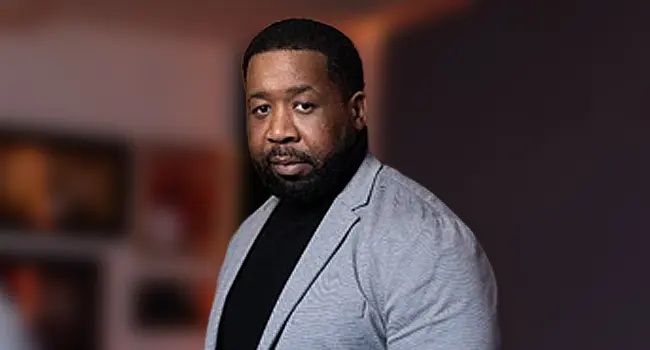
Three French police officers will go on trial next week over the beating of a black music producer they accused of failing to wear a face mask during the COVID-19 pandemic, in a rare police brutality case to reach a criminal court.
The assault on Michel Zecler, now 47, sparked widespread outrage in France and renewed debate over allegations of systemic police violence and racial discrimination. While victims and researchers say police brutality is widespread, authorities and police unions maintain that such incidents are isolated cases.
Six years after the incident, Zecler said he remained angry and was seeking accountability.
“Why me? I’ve been asking myself that question from the start,” he told AFP.
“I expect this trial to hold the police officers accountable.”
Campaigners and human rights organisations have cited the case as further evidence of what they describe as systemic racism within the French police, alleging that ethnic minorities face disproportionately harsh treatment compared with white people.
Concerns over police brutality have also resurfaced following student-led protests in recent weeks, including an incident in which a 14-year-old boy reportedly lost most of his teeth after a police officer allegedly fired a grenade at him from close range.
Police officers stopped Zecler outside his Paris studio on November 21, 2020, accusing him of failing to wear a mandatory face mask and suspecting him of cannabis use.
They pushed him into the entrance of his office and violently assaulted him in an incident captured by the studio’s security cameras.
Three officers are facing charges of intentional violence committed by a group, as well as forgery over allegations that they attempted to conceal their actions in an official report. The trial is expected to last two weeks, and the officers face up to 15 years in prison if convicted.
The lawyers representing the officers declined to comment when contacted by AFP ahead of the trial.
According to the investigation, Zecler was punched and struck with batons approximately 30 times on his face and body during an assault that lasted about five minutes.
A medical report documented craniofacial injuries, wounds to his lip and scalp, and a complete rupture of his biceps tendon, leaving him unable to work for 45 days.
France’s human rights ombudswoman said the officers used racist insults during the assault, citing the accounts of four witnesses.
However, the accused officers denied the allegations, and the alleged racist element was not included in the indictment.
‘Don’t understand the hatred’
In their initial arrest report, the officers claimed Zecler had assaulted them and attempted to seize a baton. However, footage from the studio’s security cameras, released days later by French media outlet Loopsider, contradicted their account.
“I don’t understand the hatred I saw in their eyes,” Zecler said, adding that he still suffered nightmares and had a titanium anchor implanted in his left arm following the tendon rupture.
“It was an assault that should never have happened,” he added.
“The fact they were wearing police uniforms was one of the reasons I didn’t defend myself. They are supposed to uphold law and order and act proportionately. Their conduct must be beyond reproach.”
Following the release of the footage, French President Emmanuel Macron criticised racial profiling within the police force and called for reforms.
However, Zecler expressed doubts about the effectiveness of efforts to reform the force, particularly in addressing the disproportionate use of force.

“In recent years, I’ve seen numerous cases where I didn’t feel the police officers’ lives were in danger. There was no clear reason to draw a weapon or go that far,” he said.
Rare convictions
Few allegations of police brutality in France make it to criminal court, with most cases handled through internal disciplinary procedures.
In another high-profile case, a French police officer is scheduled to stand trial over the fatal shooting of 17-year-old Nahel Merzouk at close range in June 2023, outside Paris.
Video footage of the incident also contradicted the police account, triggering nationwide protests.
Convictions in cases involving alleged police brutality remain relatively rare.
In 2024, a court handed suspended prison sentences to three officers who inflicted irreversible rectal injuries on a black man, Théo Luhaka, during a stop-and-search operation in 2017.
A report published last year by France’s human rights ombudswoman found that young men perceived as Arab, black or North African were four times more likely to be stopped by police than other members of the population.
The report, based on a survey of more than 5,000 people, also found that they were 12 times more likely to face more intrusive checks, including being subjected to searches.
AFP