

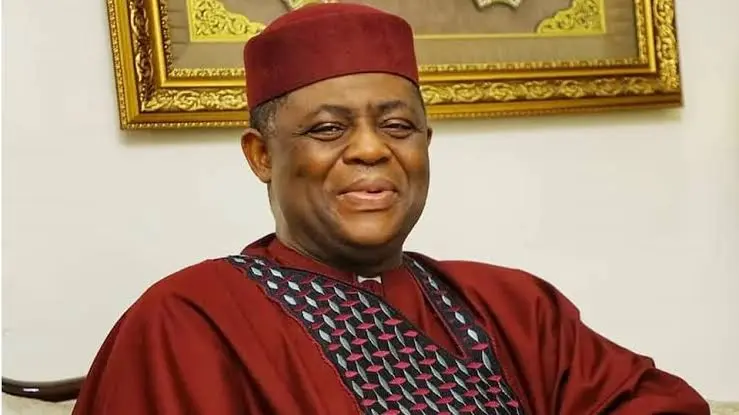
Nigeria’s High Commissioner to South Africa, Lesotho and Eswatini, Ambassador Femi Fani-Kayode, has recounted how former Libyan leader, Muammar Gaddafi, threatened to walk from the airport to Abuja after Nigerian security officials blocked his convoy over weapons discovered in vehicles accompanying his delegation during a 2006 visit.
Fani-Kayode, who was Nigeria’s Minister of Aviation at the time, said the incident occurred on November 26, 2006, when Gaddafi arrived in the country for the African and South American Heads of State Summit.
In a lengthy account shared on his X handle on Thursday to mark the 20th anniversary of the visit, the former minister said he received Gaddafi on behalf of then President Olusegun Obasanjo and was assigned to accompany the Libyan leader throughout his four-day stay.
He recalled that Gaddafi arrived with approximately 200 bodyguards, each carrying a sidearm, while about 100 vehicles had been sent ahead to transport him to Abuja.
According to Fani-Kayode, the boots of the vehicles were loaded with AK-47 rifles and other sophisticated weapons brought into the country aboard three aircraft carrying the Libyan leader and his delegation.
He said Nigerian security personnel and military officers stopped the convoy at the airport gate, explaining that although Gaddafi, his delegation and bodyguards could enter with their sidearms, the additional weapons in the vehicles would not be allowed into the country.
Fani-Kayode, who said he was travelling in the same vehicle as Gaddafi, recalled explaining the situation to the Libyan leader through an interpreter.
He said the convoy attempted to leave the airport three times but was blocked on each occasion, escalating tensions between the Libyan delegation and Nigerian security officials.
Recounting the dramatic moment, Fani-Kayode said Gaddafi eventually lost his temper, stepped out of his vehicle and began walking towards Abuja under the scorching sun, with his bodyguards and other delegation members following him.
“Gaddafi totally lost his temper, got out of his car and started walking under the burning sun, past the airport gate and towards Abuja, saying that if the cars were not allowed in, he would walk there instead. Every single one of his 200 bodyguards and delegation members walked behind him!” he recalled.
The former minister said he became concerned that the Libyan leader might collapse from the heat, as he was already sweating heavily and panting.
He added that his attempts to persuade Gaddafi to return to the airport were unsuccessful until he contacted Obasanjo, who informed him that he was on his way to the airport before travelling to Lagos.
According to Fani-Kayode, the then President asked him to tell Gaddafi that he was coming personally to resolve the disagreement.
He said the Libyan leader eventually agreed to return to the airport after receiving the message.
Fani-Kayode recalled that Obasanjo and Gaddafi exchanged warm greetings and embraced when the Nigerian President arrived. The two leaders briefly discussed the situation before Obasanjo prepared to leave for Lagos.
However, he said Obasanjo privately instructed him that the Libyan delegation must not be allowed to proceed to Abuja unless the weapons were removed from the vehicles and returned to the aircraft.
“However, as he walked past me, he bent over and whispered into my ear that under no circumstances would Gaddafi and his team be allowed in unless they complied with our request that they drop the AK-47s from the boots of their cars and put them back on their plane,” he said.
Fani-Kayode said he subsequently conveyed the instruction to Gaddafi, despite resistance from the Libyan Minister of National Security and Head of Protocol.
He alleged that the two officials were rude to Nigerian security personnel, military officers and Ministry of Foreign Affairs officials, threatening to return Gaddafi to Libya and boycott the summit if the weapons were not allowed into the country.
According to him, the Libyan officials eventually complied, with the weapons removed from the vehicles and returned to the aircraft.
He added that Nigerian soldiers surrounded the plane to ensure the weapons were not removed again before the convoy was cleared to proceed to Abuja.
Fani-Kayode also recalled that his wife, Regina, called during the standoff to inform him that the BBC was reporting the disagreement. He said he reassured her that the situation had been resolved.
He further disclosed that Gaddafi remained silent throughout their journey to Abuja, speaking only when they drove past the National Mosque, which he described as beautiful.
Reflecting on the incident, the former minister said the experience taught him important lessons about diplomacy, particularly the need for firmness, mutual respect and adherence to established rules.
“It was that day that I learnt about the intricacies of diplomacy and the fact that firmness, the display of mutual respect and a strict adherence to the rules of engagement were vital,” he said.
He praised Nigerian security personnel for standing by their instructions and commended Obasanjo for insisting that the weapons should not be allowed into the country.
Fani-Kayode further claimed that the decision was important because, according to information presented at a subsequent Federal Executive Council meeting, Libyan officials had previously brought weapons into Nigeria and handed them to local associates.
He alleged that some of the weapons later became part of arms stockpiles used by terrorists, insurgents and other non-state actors.
The former minister said Gaddafi’s attitude towards him changed after the airport disagreement was resolved, adding that they developed a cordial relationship during the summit and that the Libyan leader later invited him to visit Libya as his personal guest.
He said Gaddafi’s only complaint during the four-day engagement was that he wore a suit every day rather than traditional Nigerian attire.
“The only complaint he had was that I had worn a suit for each of those days and that he would have preferred me to wear an agbada or babariga,” he said.
Fani-Kayode also recalled Gaddafi’s death on October 20, 2011, in his hometown of Sirte, Libya, saying he was saddened after watching footage of the former leader’s killing on CNN.
“No one deserves to be killed in such a barbaric manner,” he said.
He added that Gaddafi’s violent death, despite his former position of power, demonstrated how quickly political authority could disappear.
“What hit me even more was the fact that the Head of Protocol, who spoke so loudly and aggressively on the day of our encounter and who said that if we did not allow the arms to be taken in, they would fly Gaddafi back home, was one of those condemning him on CNN all the way from Paris on the day he was murdered,” he added.