

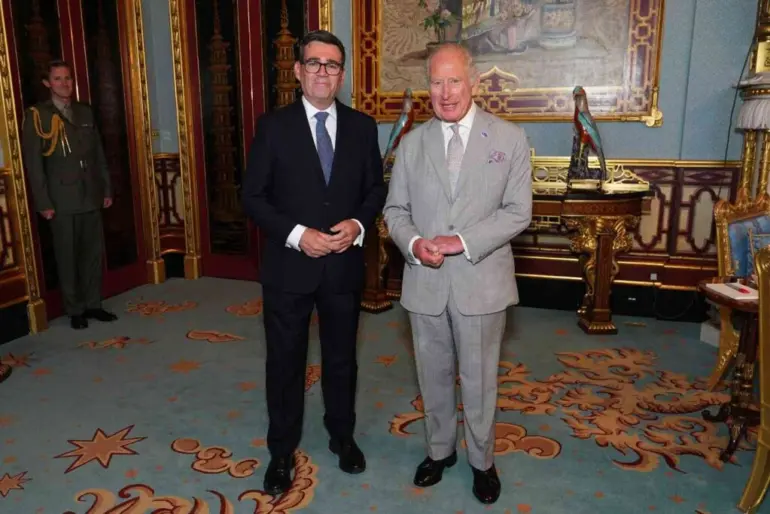
Andy Burnham officially became Britain’s prime minister on Monday after meeting King Charles III at Buckingham Palace, succeeding Keir Starmer and pledging a fresh approach to government.
Following the constitutional tradition, King Charles accepted Starmer’s resignation before inviting Burnham to form a new government. Burnham accepted, formally becoming the United Kingdom’s new prime minister.
The 56-year-old becomes Britain’s sixth prime minister in a decade and is expected to outline his vision for the country later on Monday, with a focus on restoring public confidence in government and easing the cost-of-living crisis.
Earlier, Starmer left Downing Street after delivering a farewell speech in which he defended his two-year premiership.
“I am confident that Britain is now stronger and fairer than it was two years ago,” he told reporters outside No. 10.
“I go with good grace, I go with a smile, and I go proud of everything that we have achieved.”
Burnham inherits a government facing significant economic and political challenges, leaving him little time to establish his authority.
In an interview with The Times published on Sunday, he said Britain needed to break from years of political instability.
“What we’ve been doing hasn’t been working. That’s the way I see it,” he said.
“I am going to try and do things in a different way.”
His office said his first speech would set out “priorities for restoring confidence in government and giving Britain more breathing room” as households continue to grapple with the cost-of-living crisis.
Economic growth and greater devolution of powers to regional communities are also expected to feature prominently.
Burnham is also expected to unveil his senior Cabinet appointments on Monday, with attention focused on who will replace Rachel Reeves as chancellor.
The former mayor of Greater Manchester, widely known as the “King of the North”, was drafted in by Labour after Starmer announced his resignation last month. Party MPs viewed Burnham as the strongest candidate to halt the growing electoral threat posed by Nigel Farage’s anti-immigration Reform UK party.
Economy tops agenda
Among Burnham’s most pressing challenges are sluggish economic growth, rising government borrowing costs, a growing welfare bill and continued irregular migration across the English Channel, all of which have fuelled support for Reform UK.
His premiership also begins amid volatile global energy markets following the US-Iran conflict and uncertainty surrounding the presidency of Donald Trump.
Speaking to The Times, Burnham pledged a different economic strategy.
“I would take a different approach to public spending and to running the economy — more focused on early investment, early intervention, setting people up for success and much less paying for failure,” he said.
He also promised early measures to ease pressure on household finances, saying the cost-of-living crisis dominated conversations during his campaign.
Labour returned to power in a landslide victory in the July 2024 general election, ending 14 years of Conservative rule.
However, Starmer announced his resignation in June after his administration was weakened by a series of scandals, political missteps and policy reversals.

Burnham, who returned to Parliament only four weeks ago, now faces the difficult task of governing with limited fiscal room for manoeuvre, as Britain contends with weak growth, high public debt and strict fiscal rules requiring government spending to be matched by tax revenues.
Labour’s ‘last chance’
Burnham served as an MP between 2001 and 2017 and held ministerial positions under former prime ministers Tony Blair and Gordon Brown.
Since leaving Westminster, he has built a reputation as a popular regional leader, combining a relaxed public persona with an active social media presence.
With the next general election expected in 2029, Burnham has just three years to reverse Labour’s fortunes as Reform UK continues to lead in several opinion polls.
Addressing supporters on Friday, he described his leadership as Labour’s “last chance” to regain public trust.
Critics have argued that Starmer’s government was under-prepared when it took office in 2024, but Burnham insists he has a clear plan for government.
His first major policy move came on Saturday when he scrapped Starmer’s flagship nationwide digital identity scheme, estimated to cost £1.8 billion over three years.
A spokesperson said the funds would instead be redirected “to where it’s most needed, such as helping with the cost of living.”
AFP