

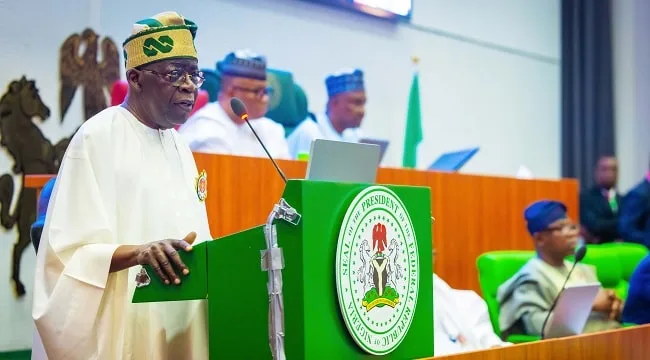
President Bola Tinubu has asked the National Assembly to approve a supplementary external borrowing plan worth $20.52bn and €1.045bn to finance infrastructure and development projects across Nigeria under the Federal Government’s 2026–2027 borrowing programme.
The proposed loans are expected to support critical sectors, including power, transportation, healthcare, agriculture, education, water supply and security, as well as employment generation and financial management reforms.
The request comes amid growing concerns over Nigeria’s rising public debt, increasing debt-servicing obligations and continued reliance on borrowing to finance government expenditure.
In April, the Federal Government increased its planned borrowing for 2026 by ₦11.31tn to ₦29.20tn, while projecting a fiscal deficit of ₦31.46tn and debt-servicing costs of ₦15.81tn, according to The Telegraph.
The administration’s borrowing strategy has attracted criticism from opposition figures and other stakeholders, particularly following the removal of the petrol subsidy, which was expected to free up government resources for infrastructure and other development priorities.
In April, Peter Obi, a former presidential candidate, warned that Nigeria risked a debt crisis, questioning the government’s continued borrowing despite the removal of the subsidy. He also raised concerns about outstanding payments to contractors and the implementation of capital projects.
The Emir of Kano, Muhammadu Sanusi II, has similarly questioned the continued reliance on borrowing after the end of petrol subsidy payments, arguing that Nigerians should see tangible benefits from the policy through improved public finances and service delivery.
However, the Federal Government has defended its borrowing strategy, maintaining that external financing is necessary to address the country’s infrastructure deficit and fund projects expected to support economic growth.
In July, Finance Minister Taiwo Oyedele also rejected claims that the Tinubu administration had borrowed about ₦80tn in three years. He explained that changes in the reported debt stock reflected factors beyond fresh borrowing, including the impact of naira depreciation on foreign-currency debt and the recognition of existing obligations.
The National Assembly has previously approved external borrowing requests to finance budget deficits and infrastructure projects. In October 2025, lawmakers approved a $2.347bn external borrowing request to partly finance the 2025 budget deficit and refinance maturing Eurobonds, alongside a proposed $500m sovereign sukuk for infrastructure projects.
While borrowing can help finance development when funds are invested in productive projects, concerns persist over debt sustainability, transparency, repayment obligations and the extent to which the loans will translate into measurable improvements in Nigerians’ living conditions.
The latest request will require legislative scrutiny before the proposed financing can proceed. Its eventual impact on public finances will depend on the amount approved, the terms of the loans, how much is ultimately drawn and the returns generated by the projects financed.