
Thick cables snake along footpaths in a township on the outskirts of Johannesburg, South Africa’s wealthiest city, where 180 households have relied on illegal electricity connections for more than two decades.
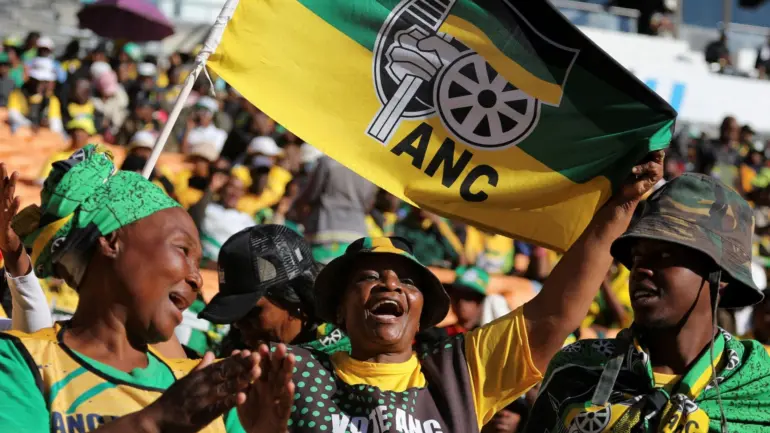
Frustrated by the authorities’ failure to provide them with legal connections to the power grid, residents have vowed to turn their backs on the African National Congress (ANC)-led municipality in the November 4 local elections, a crucial test for the once-dominant party, which has been losing support for more than two decades.
“We have made a collective decision: no electricity, no vote,” said community leader Lesiba Rankapole, 59.
Across South Africa, dissatisfaction with ANC-led municipalities has been fuelled by complaints over unreliable water supplies, poor waste collection, mismanagement and corruption.
“We know it is illegal, but we had no choice because we cannot live without electricity,” Rankapole said of the cables carrying power from another part of Katlehong, a sprawling semi-urban settlement on Johannesburg’s outskirts.
“Our children cannot progress without electricity.”
“It is obvious we are not going to vote, especially for the ANC,” said another resident, Enock Majola, 57, pointing to sites where rubbish had been illegally dumped.
“I was born ANC, but today I do not want anyone to tell me about the ANC because I am suffering,” he said.
Sliding support
At the centre of South Africa’s anti-apartheid struggle, the ANC — the party of Nelson Mandela, the jailed liberation hero who became president — secured nearly 70 per cent of the national vote in 2004.
Its support fell below 50 per cent for the first time in the 2021 municipal elections, when it won 46 per cent of the vote but retained control of nearly half of the country’s municipalities.
In the 2024 national election, the party secured just over 40 per cent of the vote, forcing it to enter a coalition government.
The ANC’s declining support has created opportunities for breakaway movements, including the uMkhonto weSizwe Party (MKP), led by former president Jacob Zuma, which is contesting local elections for the first time this year.
Elsewhere in Katlehong, Meshack Twala was digging to unblock a pipe at a house surrounded by sewage.
“How do we go and vote when our entire street has been experiencing persistent sewage problems?” he asked.
Despite his frustration, the 58-year-old acknowledged that he might still vote for the ANC if he went to the polling station.
“Changing to other parties would not feel right,” he said.
Municipal elections typically record low voter turnout, a trend that “hurts the ANC”, political analyst Sethulego Matebesi said.
However, the polls would give political parties an “idea of where their support base is” as they prepare for the 2029 national election, he added.
Matebesi predicted that no single party would secure an outright majority, leaving the country facing further coalition negotiations and hung municipalities.
Johannesburg: The big prize
Of the 257 municipal councils being contested, the battle for control is particularly fierce in Johannesburg, an economic powerhouse with more than 4.8 million residents and a prominent symbol of Africa’s most industrialised economy.
South Africa’s stark economic inequalities are visible in Alexandra township, where the skyscrapers of Sandton — often described as the continent’s richest square mile — rise in the distance.
Along Alexandra’s roads, piles of rubbish, potholes and streams of sewage underscore residents’ complaints about failing municipal services.
“The ANC has been governing for years, but we have not seen any changes in Alexandra,” said Patrick Saohatse, a 45-year-old maintenance worker.

He said he intended to vote for the liberal Democratic Alliance (DA), the second-largest party in the national coalition government after the ANC.
Already governing Cape Town, South Africa’s second-largest city, the DA has made service delivery failures and alleged mismanagement under the ANC central to its campaign, which began more than a year ago.
“Another five years of corruption and collapsing infrastructure will push our city beyond recovery,” said the party’s mayoral candidate, 75-year-old Helen Zille, at a recent rally.
With less than two weeks remaining before election day, the ANC had yet to select its Johannesburg mayoral candidate, amid what appeared to be a lacklustre campaign.
“If you look at the situation in and around Johannesburg, there are reasons for people not to be happy,” the party’s head of elections, Mdumiseni Ntuli, told AFP.
“We have made mistakes and accepted our shortcomings, but ANC remains a better option for people,” he said, urging voters to turn out.
Also seeking another chance to lead Johannesburg is Herman Mashaba, 67, the leader of the centre-right ActionSA party.
“Our refuse collection is irregular; our streets have no lights… I keep asking myself, what on earth is happening?” he told AFP.
AFP