

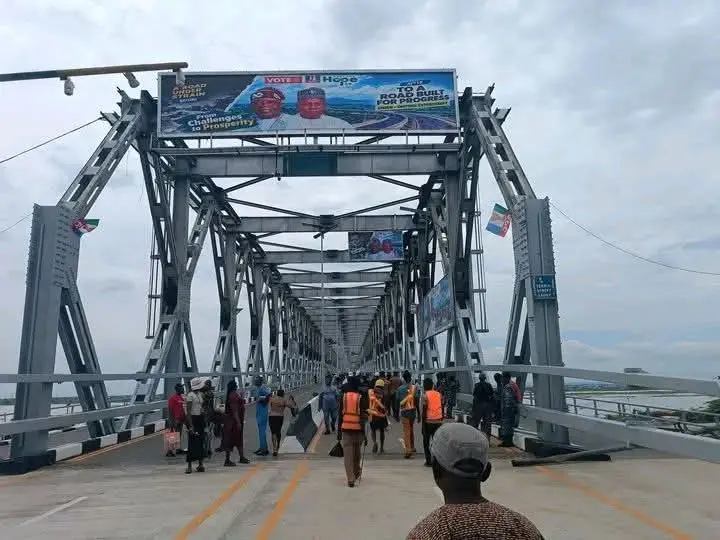
The Federal Government has reopened the First Niger Bridge, linking Onitsha in Anambra State to Asaba in Delta State, following about 38 days of closure for emergency rehabilitation works.
The Minister of Works, Dave Umahi, reopened the bridge on Thursday at a ceremony attended by federal and state representatives, as well as traditional rulers from both states.
The bridge was shut to traffic on September 7 after vandalised structural components, including steelwork around the expansion joints, were discovered, necessitating urgent repairs.
The closure, initially scheduled to end on September 21, was extended indefinitely due to persistent rainfall and other delays.
Speaking at the reopening ceremony at the Onitsha end of the bridge, Umahi urged residents of the South-East and South-South to support President Bola Tinubu’s re-election bid, citing the Federal Government’s infrastructure projects in the two regions.
“We have no regret supporting President Bola Tinubu. Let me declare, in opening this bridge, that I have no regret supporting Mr President,” Umahi said.
He described Tinubu as the most qualified person to lead the country and expressed appreciation for his administration’s infrastructure investments in the South-East and South-South.
“And so, by the power of Mr President and in our deep appreciation of what he has done for the people of South-South and South-East in this bridge, it is my humble pleasure, and with gratitude to God Almighty, to open this bridge for the benefit of our people, in Jesus name,” the minister said.
Umahi also commended the governors of Anambra and Delta states, alongside the contractor, SKCC, for their contributions to the rehabilitation project.

“We must commend the contractors, SKCC, very, very highly; they have worked very well,” he said.
The minister said the repairs were aimed at improving traffic flow and ensuring the safety of motorists and other road users, while acknowledging that some aspects of the work remained unfinished.
Completed in 1965, the First Niger Bridge is a vital transport link connecting Nigeria’s South-East and South-South regions, facilitating the movement of people, goods and services between the two geopolitical zones.