

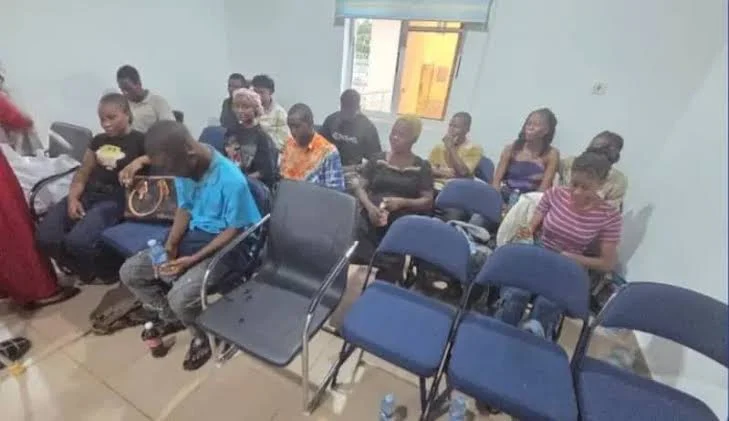
The 20 prospective corps members abducted by suspected kidnappers in Imo State have reportedly been given the option of serving in any of the six South-West states following their release.
A parent of one of the victims, who spoke to PUNCH on condition of anonymity on Friday, said the survivors had been allowed to choose their preferred states to continue their National Youth Service Corps programme.
“They have been given the opportunity to choose states in the South-West to continue their service with the current batch,” she said.
The parent also disclosed that the families paid ₦6m in ransom for each of the abducted graduates.
“As for the ransom, we eventually paid ₦6m each, but we wanted them freed before disclosing that,” she said.
The disclosure was corroborated by a relative of another survivor, Joy Zainab, who confirmed that family members and well-wishers contributed towards the ransom.
Expressing relief over the victim’s release, she said, “Alhamdulillah, he has been released and is safe with us at home. Thank you to everyone who prayed, reached out, showed concern, shared his story and supported us financially towards his ransom.”
The accounts aligned with an earlier disclosure by Alirat Wahab, the mother of another victim, who said her family paid ₦6m after the kidnappers initially demanded ₦50m per captive.
In an interview with News Central Television, Wahab said the abductors later reduced their demand to ₦15m before eventually accepting ₦6m following appeals from the family.
“Initially, they asked us to pay ₦50m per head. We asked whether the amount was for all of them, but they insisted it was per person, so we started begging them to take ₦500,000, but they refused,” she said.
Wahab said the kidnappers eventually agreed to accept ₦6m, adding that relatives and well-meaning Nigerians contributed towards raising the money.
According to her, the abductors directed the families to send representatives to Ibadan, Oyo State, where her husband and son met an intermediary.
The ransom was subsequently transferred into a designated account, while the representatives were instructed to convert the money into US dollars upon arrival in Imo State.
The 20 prospective corps members were abducted on October 1 along the Owerri-Onitsha Road, near Umunoha in the Mbaitoli Local Government Area of Imo State, while travelling in two commercial buses operated by Uko Akwa Ibom Motors.
They were reportedly travelling to Abia and Akwa Ibom states when they were seized. The kidnappers subsequently demanded ₦50m for each captive.
On Wednesday, the police announced that the abducted graduates had been rescued at Amakohia Ubi Village in the Owerri West Local Government Area of Imo State.
However, the victims’ families disputed the police account, insisting that ransom payments were made to secure their release.
The mother of another survivor disclosed that she and her daughter had been hospitalised following the incident.
“Both of us are in the hospital. We are receiving drips and treatment. My blood pressure shot up over this incident,” she said.
Efforts to obtain confirmation from the NYSC spokesperson, Caroline Embu, on whether the graduates had been permitted to serve in the South-West were unsuccessful, as calls and messages to her had not been returned as of press time.
Police cite security operations
The Imo State Commissioner of Police, Audu Bosso, said on Thursday that he was unaware of any ransom payment, maintaining that sustained security pressure forced the abductors to release the victims.
Similarly, the Force Public Relations Officer, CSP Anietie Iniedu, said the graduates were rescued through joint search-and-rescue operations involving security agencies.
According to the police, the prospective corps members were taken to the Department of State Services hospital in Owerri for medical evaluation.
The Director-General of the NYSC, Brigadier General Olakunle Nafiu, also visited the survivors alongside the Imo State Commissioner of Police and the Commander of the 34 Artillery Brigade.
The abduction, coupled with other attacks on graduates travelling for national service, has renewed concerns about the safety of prospective corps members, particularly those travelling long distances to orientation camps.
On August 26, 15 prospective corps members travelling from Bayelsa State to Abuja were abducted along the Aloma-Egane Expressway in the Ofu Local Government Area of Kogi State. They were later rescued by security operatives from Egume Forest.
In May, an Abuja-based lawyer and serving corps member, Eunice Ameh, was abducted in Maitama, Abuja, but regained her freedom after a ransom was reportedly paid.

Insecurity fuels calls to scrap NYSC
The recurring attacks have intensified debate over the future of the 53-year-old NYSC scheme, with critics questioning the policy of deploying young graduates to states far from their places of origin amid worsening security concerns.
The National Youth Service Corps was established under Decree No. 24 on May 22, 1973, during the administration of General Yakubu Gowon.
Its founding objectives included promoting national reconciliation, reconstruction and integration following the Nigerian Civil War by deploying graduates of tertiary institutions to states other than their states of origin.
In June 2026, the Federal Executive Council approved a comprehensive reform package for the scheme. The measures included risk-sensitive deployment to improve corps members’ safety, a technology-driven call-up process and an extension of the orientation programme from three to six weeks.
The reforms also provided for specialised career streams designed to align corps members’ training and assignments with their qualifications and career interests.
However, the latest abductions have raised questions about the implementation of the proposed safety measures, particularly for graduates travelling long distances to orientation camps and those posted to areas facing security threats.
A former corps member, Veronica Oloko, called for the scheme to be scrapped, arguing that young Nigerians should not be exposed to severe security risks in the course of national service.
“If it won’t be scrapped, then the government should have bus stations for corps members all over the states, with soldiers stationed at the parks. At least, a few soldiers should be in each bus, with the necessary equipment to protect the corps members.
“But then, this is also a risk because even our soldiers are being attacked in their camps. When the government is able to fight insurgency, then they can return it. I won’t even allow my child to go,” she said.
Another parent, Akeem Kareem, also backed calls to scrap the scheme, citing widespread security concerns.
“There is fear among every parent now due to insecurity. No parent will allow their children to go to other regions for service,” he said.
