

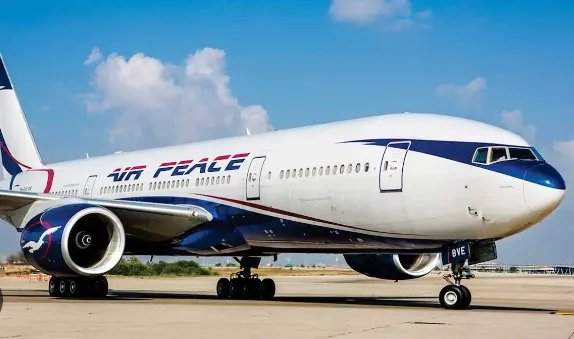
The management of local airline Air Peace has described as “inaccurate” a recent flight delay report released by the Nigeria Civil Aviation Authority (NCAA), disputing the figures used to assess the airline’s operational performance in August 2026.
In its August 2026 summary of domestic airline flight operations, the NCAA reported that Air Peace recorded 1,330 delayed flights out of 1,864 flights operated during the month. The report, however, did not provide details on the causes of the delays attributed to the airline.
Responding to the report, Air Peace, in a statement signed by its Chief Operating Officer, Oluwatoyin Olajide, said the NCAA’s figures contained “fundamental data inaccuracies” regarding the airline’s operational volume and failed to properly distinguish between delays caused by the airline and those resulting from external factors.
“The said data failed to reflect the reality of our operations, nor does it accurately contextualize the primary drivers of the operational disruptions experienced during the said month,” the airline said.
Air Peace claimed that the NCAA significantly underreported its total flight volume for August.
“First and foremost, the NCAA report vastly underreported our total flight volume. Air Peace operated a total of 2,564 flights in August 2026, as opposed to the 1,864 flights stated in the NCAA report,” the airline said.
According to the carrier, excluding more than 700 flights from the NCAA’s data set distorted its performance metrics and resulted in an inflated delay percentage.
“By omitting over 700 fully operational flights from the data pool, the NCAA’s calculations skew our actual performance metrics and artificially inflate the reported delay percentages,” it said.
The airline also questioned why the NCAA’s monthly reporting series began with August rather than July, following the publication of its first- and second-quarter reports on July 31.
“It is indeed worrisome that there is still no equivalent monthly data located for July, yet the NCAA published unusually granular August airline delay data only 13 days after month-end,” Air Peace said.
The airline further criticised what it described as the early publication of the August report, arguing that the report should have acknowledged the industrial action that disrupted aviation operations during the month.
“It is reasonable to suggest that the early release of the August publication should have been accompanied by disclosure that the month contained an extraordinary aviation-sector industrial disruption which significantly affected the airline’s operations,” it said.
Air Peace said the union disruption that began on August 11 affected its operations for more than two weeks, resulting in flight rescheduling, delays and cancellations.
“The effect of the August 11th instigated Union disruptions of our operations lingered for over 14 days, leading to rescheduling, avoidable delays and cancellation of flights,” the airline said.
The carrier also questioned why the NCAA report did not identify the causes of the delays attributed to individual airlines.
“Why was this report published rapidly without identifying the causes of the delays attributed to individual airlines instead of publishing wrong figures that could tarnish the reputation of the airline despite prevailing operational challenges?” it asked.
Air Peace argued that the NCAA’s reporting did not adequately distinguish between delays resulting from the airline’s internal operations and those caused by external or systemic factors beyond its control.
According to the airline, its internal review of its August 2026 flight performance data showed that 391 delayed flights, representing about 15 per cent of the delays recorded during the month, were attributable to internal factors.
“From the above, only 391 flights should be attributed to Air Peace, which represents 15% of the delays in that month,” the airline said.
The carrier said the internal causes were largely related to technical issues, including unscheduled aircraft maintenance and fuel-related challenges.
It attributed the remaining delays to a range of external factors, including airport congestion and traffic, bird strikes, unexpected breakdowns of airport facilities, adverse weather conditions and the picketing of the airline by aviation union members.

Air Peace also cited aircraft damage caused by a ground-handling company among the external factors that contributed to delays.
“Again, the narrative that Air Peace is primarily responsible for these delays is completely false. The majority of the delays experienced by our passengers were driven by external factors and completely outside of our control,” the airline said.
“In stark contrast, delays caused by internal operational factors accounted for just 15% of the total delays experienced during the month of August.”
The airline said it had previously refrained from publicly responding to the figures but was compelled to do so because of what it described as the need to correct the record.
“We have restrained ourselves from making these facts public before now, but we have now been pushed beyond acceptable limits, hence the need to go public and state the facts the way they are,” it said.
Air Peace added that it had made significant investments in its fleet, crew availability, training and maintenance protocols as part of efforts to improve operational reliability.
“We remain fully committed to safety, on-time performance and passenger satisfaction; however, an airline cannot safely or logistically bypass severe airport congestion/traffic, inadequate airport infrastructure, sunset restrictions or adverse weather conditions,” the airline said.
It added that it would continue to optimise its internal processes to reduce delays arising from factors within its control.
Air Peace urged the NCAA to review and audit its data-collection methods to ensure that future reports accurately capture airlines’ operational volumes, the causes of delays and the broader operating environment within Nigeria’s aviation sector.
