

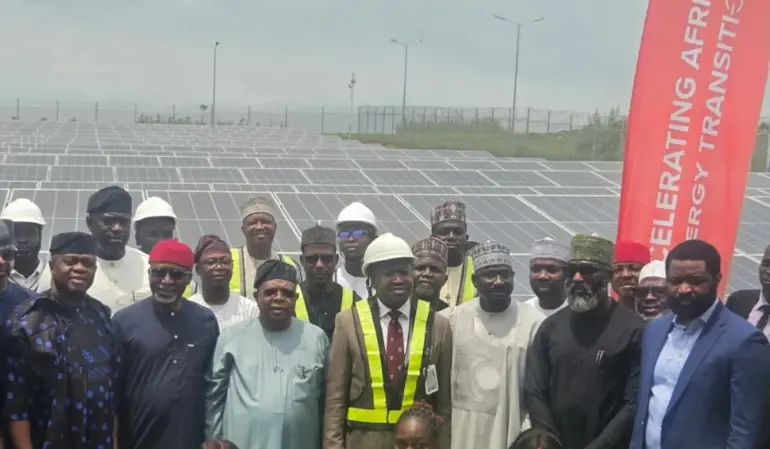
The Federal Government has commissioned a 3MW solar hybrid power project at Yakubu Gowon University, Abuja, formerly the University of Abuja, to strengthen electricity supply for teaching, research, laboratory work and other critical campus operations.
The project, delivered under Phase II of the Energising Education Programme (EEP), was commissioned on Wednesday by the Minister of Power, Joseph Tegbe, in collaboration with the Rural Electrification Agency (REA) and the World Bank-funded Nigeria Electrification Project.
The intervention comes as universities continue to grapple with the challenge of providing reliable electricity for academic activities, digital services, student accommodation and campus security.
Tegbe, who described the commissioning as a significant moment because he was returning to his alma mater, said the project demonstrated the importance of linking energy investment with human capital development.
“There is perhaps no better place to demonstrate the practical value of Nigeria’s energy transition than a university. A university brings together everything that a modern energy system is expected to support: learning, research, healthcare, technology, administration and, increasingly, the digital infrastructure through which knowledge is created and shared,” he said.
According to the minister, the facility combines a 3.3MW solar array with 3MW of AC output capacity and 2MWh of battery storage to provide power for critical loads beyond solar hours.
Tegbe said the project was only the beginning of efforts to improve electricity supply across the university, following a request by the Student Union Government for power to be extended to student hostels and other areas of the campus.
“What you can be sure of is that we will look into it, and we’ll make sure the battery system… We currently have three megawatts of solar panel capacity, and we’ll have three megawatts of battery capacity. Typically, with this kind of project, what you do is double the battery capacity so that your storage capacity is much higher, and then you can serve other areas,” he said.
He added that the university’s Vice-Chancellor had also raised the issue with him, assuring the institution that efforts were underway to extend power coverage.
“I will make sure that in the next six months, every other area will be covered,” Tegbe said.
The project also includes 388 streetlights designed to improve campus illumination and enhance security.
Tegbe urged the university community to protect the infrastructure from vandalism, saying the government was working with security agencies to safeguard critical national assets.
“We set up a joint working committee with EFCC, with the police, with the civil defence corps, to monitor our national assets. You will not believe how many towers get pulled down by vandals. There are big vandals all over the country,” he said.

The minister also announced plans to establish systems for the long-term maintenance of renewable energy infrastructure after commissioning.
He said the Renewable Asset Management Company would support the maintenance of renewable energy assets, adding that a similar arrangement was being developed for national grid infrastructure.
The Managing Director and Chief Executive Officer of the REA, Abba Aliyu, said the Energising Education Programme had so far delivered renewable energy infrastructure to 22 federal universities and three affiliated teaching hospitals, with more than 100MW of clean energy deployed.
Aliyu urged the university to use the project as a platform for research and innovation in renewable energy, battery storage, grid integration, smart metering and energy management.
The Vice-Chancellor of Yakubu Gowon University, Professor Hakeem Babatunde Fawehinmi, described the project as a major investment in the university’s academic mission and a boost to the institution’s capacity to provide a more reliable and sustainable power supply for its community.