

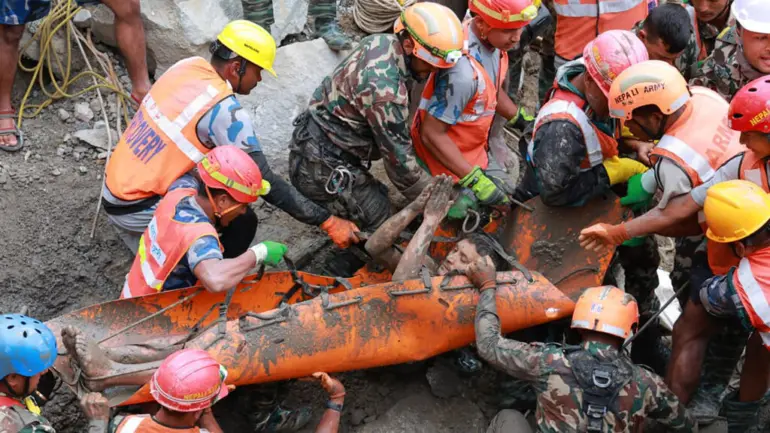
Two hydropower workers were rescued alive on Friday from a tunnel buried under debris in Nepal, offering a rare moment of hope on the 10th day of rescue efforts following catastrophic flooding in the Himalayas.
Rescuers cheered as the first man was pulled through a muddy opening, footage released by Nepal’s energy ministry showed. He was helped to his feet before being carried on rescuers’ backs and rushed towards a helicopter, raising one hand as he was taken to safety.
A photograph showed the second survivor, covered in mud and with his hands pressed together in prayer, being carried out on a stretcher.
“As long as there is breath, there is hope!” Energy Minister Biraj Bhakta Shrestha said in a statement.
“Rescue operations are continuing in all the affected tunnels. Let everyone’s efforts and prayers continue. We have not lost hope.”
The rescue was hailed as a “miracle” after the August 26 glacial and mountain collapse on the China-Nepal border killed at least 1,325 people and left more than 5,500 missing.
“I am so happy, my heart is lighter,” Amir Maharjan, brother of 45-year-old rescued worker Kabir Maharjan, told AFP.
The second survivor, 30-year-old Sanjay Sah, said he had survived the days trapped in darkness by praying.
“What day is today? I was chanting maha mantra (Hindu prayers) inside,” Sah said in a video broadcast by Nepali media shortly after his rescue.
He said he believed other workers could still be inside the tunnel.
“There were as many as 40 or 45 people… I told them and everyone to run out,” he said, recalling the moment the disaster struck.
Both men were reported to be in stable condition at a hospital in Kathmandu.
‘24/7 heartache’
Maharjan’s wife, Hira Shobha Maharjan, said her husband was able to speak but had injured his leg and was struggling to move his hands because of the cold.
“He can talk, he is okay. He has strength to talk and recognised me. At first he did not, but now he does,” she said.
His sister-in-law Lakshmi Naini waited outside the Kathmandu hospital after he was flown there by helicopter.
“It’s a miracle. I am very happy,” she told AFP. “I heard he is alive through social media, and I could not believe it.”
“I have no words to express how I feel,” another relative, Shyam Maharjan, 45, said.
The two men were among hundreds of hydropower workers reported missing after a massive wall of mud and debris swept through the region following a glacial and rock collapse on a mountain along the China-Nepal border.
Search operations continued at the Trishuli 3A tunnel, where the men were rescued, as well as at several other sites. At least 12 hydropower projects were damaged or destroyed by the floods.
The government initially said it believed more than 100 workers could still be alive inside multiple tunnels.
Nepali rescuers, supported by experts from India, China and South Korea, had repeatedly encountered hard-packed debris while searching for survivors. Until Friday, no tunnel worker had been confirmed alive.
Australian rescue expert Arnold Dix, who has been advising the operation, described the rescue as a return to “miracle country” after what he called a week of “24/7 heartache”.
Earlier on Friday, Dix said rescue teams at the Trishuli 3A project had detected a faint response from inside the tunnel.
“They believe they received a faint response from inside saying, ‘hunchha’, yes or OK,” Dix, president of the International Tunnelling and Underground Space Association, told AFP.
He said rescuers had called into the tunnel: “Don’t worry, we are rescuing you.”

Teams had dug through debris blocking the tunnel for between 50 and 60 metres (164-197 feet), Dix said, adding that they were hoping for a breakthrough at any moment.
Less than an hour later, the two men were pulled to safety.
‘Himalayan tsunami’
The rescue came as hopes had begun to fade for many families still searching for missing relatives. Some had started holding symbolic funerals in recent days.
Nepal’s Foreign Minister Shisir Khanal described the enormous wave of debris triggered by the rock and ice avalanche as a “Himalayan tsunami”.
The floods tore through mountain districts, destroying roads, bridges and multiple hydropower dams, while leaving communities near the epicentre cut off.
The United Nations has warned that the “magnitude of the destruction” is making the delivery of aid extremely difficult, with cargo drones and porters being considered to reach isolated communities.
“Families have lost everything,” UN Nepal chief Lila Pieters Yahia said on Friday as the UN launched a $50 million appeal to assist more than 84,000 people.
Nepal’s disaster authority said 1,294 bodies had been recovered and 5,053 people remained missing as of Friday evening.
In China, state media reported 31 deaths and 531 people missing.
Across the two countries, the disaster has killed at least 1,325 people and left 5,584 missing. More than 800 foreign nationals from at least 34 countries are among those reported missing.
