

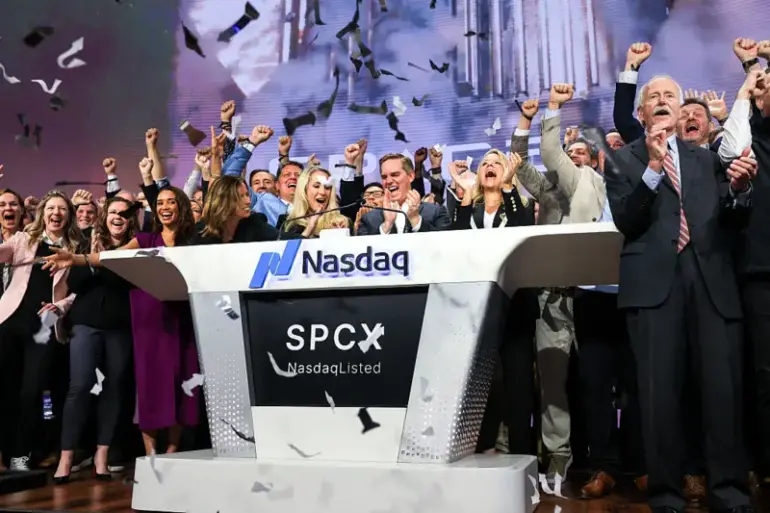
Elon Musk’s SpaceX made its debut on Wall Street on Friday following the largest initial public offering (IPO) in history, with the billionaire entrepreneur using the milestone to reiterate his ambition of taking humanity to Mars.
The blockbuster offering raised more than $75 billion and is expected to propel Musk toward becoming the world’s first trillionaire. The listing is also seen as the opening act in a wave of anticipated IPOs from major artificial intelligence companies in the months ahead.
Trading of SpaceX shares began on the Nasdaq in New York, with investors closely watching demand for the company’s stock.
“SpaceX wants to be able to take you to the Moon, take you to Mars, and ultimately beyond,” Musk said during a launch event at Starbase, Texas, surrounded by employees.
“I’m confident that, with the incredible team we have here at SpaceX, we will achieve that,” he added.
Outside Nasdaq’s headquarters in New York, supporters and investors gathered to mark the occasion, while a giant neon sign in Times Square displayed the message: “Building the infrastructure to the future.”
“Musk sets very futuristic goals that no one else is pursuing, and I think that has people excited,” said Sarin Sio of financial firm Dovetail.
SpaceX priced more than 555 million shares at $135 apiece, according to a filing with U.S. regulators, giving the company a valuation of nearly $1.8 trillion. That places it among Wall Street’s 10 most valuable companies, ahead of Tesla, Meta, and Walmart.
An option to purchase nearly 83 million additional shares could increase the total amount raised to more than $86 billion.
Founded by Musk in 2002, SpaceX has evolved from a rocket startup into a major satellite operator. The company has also integrated Musk’s artificial intelligence venture, xAI, which includes social media platform X, formerly known as Twitter.
The company trades under the ticker symbol “SPCX,” and its market debut is being closely watched as a potential bellwether for other AI-focused firms considering public listings.
SpaceX is the first major AI-linked company to reach public markets, with OpenAI and Anthropic reportedly preparing for future offerings.
The IPO comes just over a year after Musk departed President Donald Trump’s administration, where he briefly led the controversial Department of Government Efficiency (DOGE) initiative aimed at reducing federal spending while continuing to oversee Tesla and SpaceX.
Musk’s support for Trump and right-wing populist movements in Europe, coupled with his often-controversial commentary on X, has transformed him from a widely admired innovator into one of the world’s most polarizing business figures.
Despite that, investor enthusiasm remains strong. Bloomberg reported that the offering was more than four times oversubscribed, with significant demand from retail investors, who were allocated 20 percent of the shares.
Data centres in space
The IPO is expected to create thousands of new millionaires and several billionaires among current and former employees, as well as long-time investors.

However, some analysts have raised concerns about the company’s lofty valuation, which depends heavily on Musk delivering ambitious projects that include establishing data centres in space and sending humans to Mars using technology that remains under development.
Future growth is also tied to a significant expansion of Starlink, SpaceX’s satellite internet service, as well as the success of xAI, the developer of the Grok chatbot and a competitor to OpenAI and Anthropic.
Although SpaceX’s revenue climbed to $18.7 billion in 2025, the company reported a net loss of $4.9 billion, largely driven by investments in AI infrastructure.
In one of the most ambitious projections ever included in a corporate filing, SpaceX stated that its various markets could eventually generate more than $28.5 trillion in revenue.
If those ambitions are realised, Musk could become history’s first trillionaire, further widening the gap between himself and the world’s other wealthiest individuals.
AFP
