

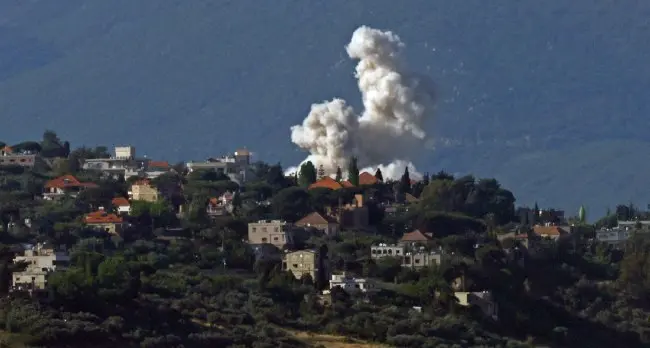
The United States and Iran exchanged fresh strikes on Monday, further straining an already fragile ceasefire as negotiations aimed at ending the conflict remain deadlocked.
Weeks of difficult talks, marked by sharp rhetoric and intermittent violence, have failed to produce an agreement to end the war and reopen the Strait of Hormuz, a critical artery for global oil supplies.
Washington and Tehran remain divided on key issues, including Iran’s nuclear programme and the conflict in Lebanon, which Iran insists must be addressed as part of any comprehensive deal.
The latest exchange of fire came as Israel expanded its military offensive in Lebanon, with Prime Minister Benjamin Netanyahu pledging to push deeper into the country.
The US military said it carried out “self-defence strikes” over the weekend against Iranian radar installations and drone-control facilities in southern Iran — the third such operation in just over a week.
According to Washington, the strikes were launched in response to the downing of a US MQ-1 drone.
Shortly afterward, Iran’s Revolutionary Guards announced that they had targeted an “air base from which the attack originated” that was being used by US forces. State broadcaster IRIB reported the claim but did not specify the location of the base.
The announcement followed a statement from Kuwait’s military, which said its air-defence systems intercepted “hostile missile and drone attacks” without identifying their source.
Sticking points in negotiations
Iran was already engaged in talks with the United States over its nuclear programme when US and Israeli air and missile strikes in February killed several senior figures within the Islamic Republic’s leadership.
Tehran has consistently maintained that its nuclear activities are intended solely for civilian purposes. However, the United States and its Western allies suspect Iran is seeking to develop nuclear weapons.
The New York Times and Axios reported on Saturday that President Donald Trump had submitted a tougher negotiating framework for Iran’s consideration, although details of the proposal remain unclear.
Trump has repeatedly said his priorities include preventing Iran from acquiring nuclear weapons and restoring free navigation through the Strait of Hormuz, which Iran has blockaded since the outbreak of the conflict.
“The one guarantee that I have to have is that there will be no nuclear weapons. They’ve agreed to that, and it was very interesting,” Trump said during an interview with his daughter-in-law, Lara Trump, on Fox News.
Late Sunday, the US president reiterated on Truth Social that the proposed agreement “states, very clearly, that Iran will not have a Nuclear Weapon”.
Iranian officials, however, have cast doubt on Trump’s claims, insisting that significant differences remain.
“We will not approve any agreement until we are certain that the rights of the Iranian people have been upheld,” Iran’s chief negotiator, Mohammad Bagher Ghalibaf, said in remarks broadcast on state television.
According to the Tasnim news agency, negotiations remain active, with both sides continuing to exchange revisions to the draft agreement.
Foreign Minister Abbas Araghchi also cautioned against speculation, saying that “until a clear conclusion is reached, everything that is being said now is speculation,” according to state television.
Iran has demanded access to $12 billion in frozen assets before entering substantive discussions on its nuclear programme. Iranian media also dismissed Trump’s earlier assertion that the country’s stockpile of enriched uranium would be destroyed under a future deal as “baseless”.
Meanwhile, Trump faces growing pressure to secure an agreement that would end competing US and Iranian restrictions around the Strait of Hormuz, whose disruption has affected global energy markets.
After Trump suggested that Iran would impose “no tolls” on vessels passing through the waterway under any agreement, Iran’s Fars news agency cited sources denying that such a provision existed in the draft framework.

On Saturday, ISNA quoted lawmaker Alireza Salimi as saying a proposal aimed at strengthening Iranian “management and sovereignty” over the strait — including the introduction of administrative fees — would soon be presented to parliament.
Lebanon front
Tehran has also insisted that developments in Lebanon form part of any broader peace settlement.
Fighting there continues, with Beirut accusing Israel of pursuing a “scorched-earth policy” as it intensifies operations against the Iran-backed Hezbollah movement.
Although a ceasefire between Israel and Hezbollah formally took effect on April 17, both sides have repeatedly accused each other of violating the truce.
An Israeli strike in southern Lebanon on Sunday killed eight people, including three women, according to the Lebanese Health Ministry.
Diplomatic sources told AFP that the UN Security Council is scheduled to hold an emergency meeting on Monday to discuss Israel’s expanding military campaign following its capture of the strategic medieval Beaufort Castle.
Netanyahu described the recapture of Beaufort as “a dramatic shift” in the conflict.
AFP