

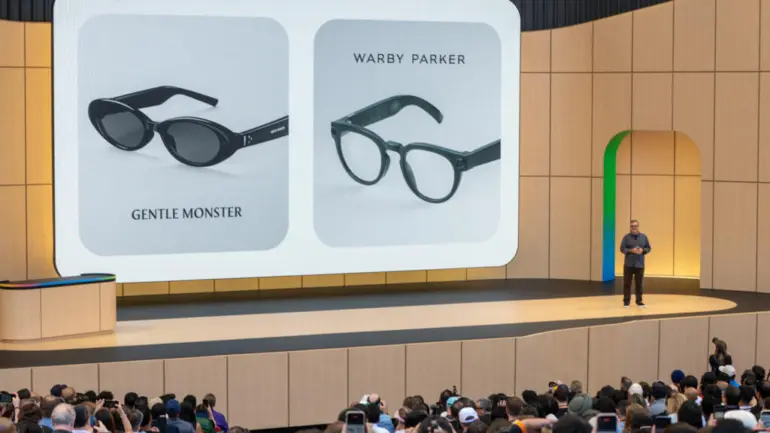
Google on Tuesday unveiled a new generation of smart glasses, marking the tech giant’s return to a market it famously failed to conquer more than a decade ago with Google Glass.
The new wearable devices, expected to launch later this year, will place Google in direct competition with Meta, whose Ray-Ban smart glasses have established an early lead in the fast-growing sector, with more than seven million units reportedly sold.
Google’s latest offering — described as “audio glasses” — will feature a microphone, camera and built-in speakers, allowing users to make calls, listen to music, capture photos and interact with the company’s Gemini AI assistant.
The company did not announce a specific release date or pricing details during the unveiling at its annual Google I/O developer conference in Mountain View, California.
Google showcased two eyewear collections developed in partnership with fashion brands Warby Parker and Gentle Monster, while Samsung handled the underlying hardware and technical development. The smart glasses will support both Android and Apple devices.
For Google, the launch represents a significant comeback attempt in a category where it previously suffered one of its most notable setbacks.
The original Google Glass, introduced in 2013, drew widespread criticism over privacy concerns due to its integrated camera and futuristic design. The product was eventually discontinued after failing to gain mainstream acceptance.
This time, however, Google appears determined to avoid the same mistakes by placing greater emphasis on style, usability and everyday appeal.
Still, the inclusion of cameras is likely to revive some of the privacy and surveillance concerns that have also trailed Meta’s smart glasses.

Google additionally revealed that it is developing a more advanced version featuring a built-in display — similar to the upgraded smart glasses Meta introduced in late 2025.
The company said the display-equipped model, which was first shown as a prototype last year, has made further progress in developer testing, though no additional specifications or launch timeline were disclosed.