
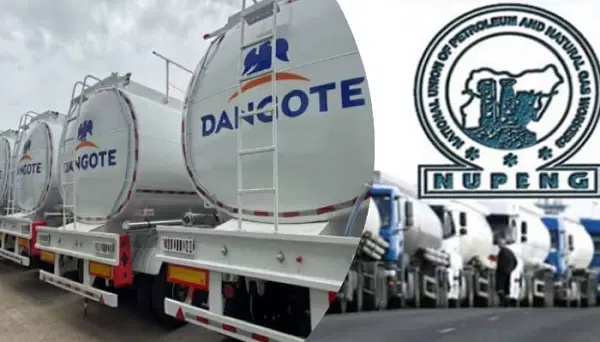
The Nigeria Union of Petroleum and Natural Gas Workers (NUPENG) has suspended its nationwide strike following a breakthrough agreement with the management of Dangote Refinery to recognise workers’ rights to unionise.
The resolution came after a closed-door meeting brokered by the Department of State Services (DSS), and attended by the Minister of Finance, Wale Edun; representatives of the Nigeria Labour Congress (NLC); and top officials from the Federal Ministry of Labour and Employment.
Acting NLC General Secretary, Benson Upah, confirmed the agreement, while the Ministry of Labour announced that an official statement would be issued shortly.
Union rights recognised under MoU
According to a Memorandum of Understanding (MoU) signed by all parties, the management of Dangote Refinery and Petrochemicals affirmed that employees who wish to unionise will be allowed to do so—acknowledging that unionisation is a fundamental right under Nigeria’s labour laws.
The MoU stipulates that the unionisation process will commence immediately and be completed within two weeks, from September 9 to 22, 2025. Crucially, the document also ensures that no worker will face victimisation as a result of the strike or for seeking to join a union.
The MoU stated that since workers’ unionisation is a right in line with the provisions of the extant laws, the management of Dangote Refinery and Petrochemicals agreed to the unionisation of employees who are willing to unionise. It was also agreed that the employer will not set up any alternative or parallel union.
Strike suspended, monitoring to continue
In compliance with the agreement, NUPENG immediately suspended its strike action. Both parties are expected to report back to the Minister of Labour one week after the completion of the unionisation process.
The MoU was signed on behalf of the Dangote Group by Sayyu Dantata, Managing Director of Dangote Group; O.K. Ukoha of the Nigerian Midstream and Downstream Petroleum Regulatory Authority (NMDPRA); and Ojimba Jibrin, also of the Dangote Group.
On the labour side, it was signed by Benson Upah of the Nigeria Labour Congress (NLC), N.A. Toro of the Trade Union Congress (TUC), NUPENG President Akporeha Williams, and NUPENG General Secretary Afolabi Olawale.
The Federal Ministry of Labour and Employment was represented by Amos Falonipe, Director of Trade Union Services and Industrial Relations, who signed on behalf of the Minister.
Background: Tensions over driver unionisation
The dispute began when NUPENG, which represents fuel tanker drivers, accused Dangote Refinery of hiring new drivers on the condition that they not join a union. The refinery’s management denied the allegations, calling them “cheap blackmail.”

Opened last year, the 650,000-barrel-per-day Dangote Refinery is Africa’s largest and was expected to reduce Nigeria’s dependence on imported petroleum products. While it has contributed to lower pump prices and reshaped the downstream market, its dominance has raised concerns over monopolistic practices.
Tensions were further inflamed by Dangote Group’s plan to deploy thousands of compressed natural gas (CNG)-powered trucks, a move that would disrupt the existing fleet of over 20,000 diesel-powered tankers—many operated by unionised drivers.
During the strike, Dangote Group spokesperson Anthony Chiejina assured the public there was no fuel shortage and that negotiations were ongoing.
NUPENG’s strike action received strong support both domestically and internationally. The Nigeria Labour Congress (NLC), global union federation IndustriALL (based in Switzerland), and the International Lawyers Assisting Workers (ILAW) Network in Washington, D.C., all expressed solidarity with the workers’ right to organise.