

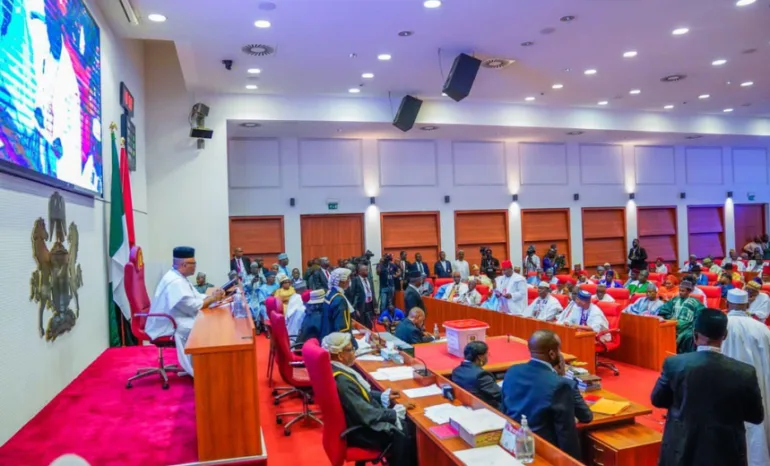
The Senate has explained that the Federal Capital Territory (FCT) was excluded from the proposed state police framework because it does not have a governor or a State House of Assembly and remains under the direct administration of the Federal Government.
The Chairman of the Senate Committee on Media and Publicity, Yemi Adaramodu, gave the explanation on Frida amid questions over why the FCT was not included in the constitutional framework for the establishment of state police.
Adaramodu said the administrative structure of the FCT was fundamentally different from that of Nigeria’s 36 states, noting that the territory is headed by a minister who operates under the Federal Executive Council.
The Ekiti lawmaker added that legislative powers over the FCT are exercised by the National Assembly, unlike in the states, where elected governors and Houses of Assembly oversee executive and legislative functions.
“I have heard many people raise a lot of questions on why the Federal Capital Territory is not among the plans for state police. The FCT issue is different. It is under the Federal Government.
“Again, the FCT does not have a governor. It is run by a minister who subscribes to the Federal Executive Council. It is from this FEC that the FCT takes directives and its administrative relevance.
“So, the Federal Capital does not have an assembly. It is the National Assembly that legislates for the FCT. This is why it can’t be different from what the Federal Government does. Therefore, the federal police are in charge,” he said.
The clarification comes as the Federal Government moves to establish a new policing architecture following growing calls for the decentralisation of policing and constitutional backing for state police.
The Presidency had announced that President Bola Tinubu was expected to receive the draft Executive National Policing Bill on September 3 as part of efforts to overhaul the country’s policing system.
The Chief of Staff to the President and Chairman of the Presidential Working Group on the National Policing Bill, Femi Gbajabiamila, disclosed this after a meeting of the group at the Presidential Villa, Abuja.
He also unveiled a public information portal through which Nigerians can submit memoranda and position papers to help shape the proposed legislation before its consideration by the President and eventual transmission to the National Assembly.
While the constitutional amendment provides the legal foundation for the establishment of state police, the Executive Bill is expected to provide the operational framework for implementing the new policing architecture.
Funding, oversight questions
The proposed framework has, however, generated debate over the funding and administration of state police.
Under the constitutional amendments, State Houses of Assembly would have powers to make laws relating to the establishment, organisation, administration, funding and oversight of state police.
The framework places primary funding responsibility on state governments while also allowing for federal grants or assistance.

A new provision, Section 216A, stipulates that the Federal Government may provide grants or aid to state police on the recommendation of the National Police Council, subject to approval by the National Assembly.
However, the provision does not specify a minimum federal contribution, funding formula or guaranteed revenue stream for state police.
This means that while states would be expected to bear the primary financial responsibility for their police forces, access to federal assistance would depend on a recommendation by the National Police Council and subsequent approval by the National Assembly.
The National Police Council is chaired by the President and comprises other senior federal and state officials, making the proposed funding mechanism a potentially important aspect of the relationship between state governments and the Federal Government once the new policing system becomes operational.
The FCT, however, would remain outside the arrangement under its existing constitutional structure, according to Adaramodu, because the territory is administered directly by the Federal Government and lacks the institutional structures of a state.
As the proposed state police framework undergoes further harmonisation and legislative processes, how policing will operate in the FCT is likely to remain closely tied to the territory’s unique constitutional and administrative status.
