

The Federal Competition and Consumer Protection Commission (FCCPC) has warned that Nigeria’s emerging state electricity markets could struggle to attract investment if states adopt conflicting regulatory standards.
The commission called for stronger collaboration among federal and state electricity regulators, stressing that a harmonised consumer protection framework is essential to safeguard electricity users and provide regulatory certainty for investors under the Electricity Act 2023.
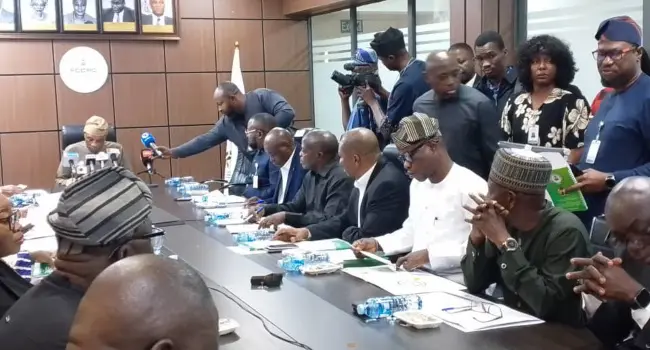
Speaking on Thursday at a stakeholders’ engagement on consumer protection and regulatory cooperation in Nigeria’s electricity sector in Abuja, the Executive Vice Chairman and Chief Executive Officer of the FCCPC, Tunji Bello, said consumers should enjoy the same level of protection regardless of where they live.
The meeting brought together officials of the Nigerian Electricity Regulatory Commission (NERC), the Nigerian Electricity Management Services Agency (NEMSA) and state electricity regulatory commissions following the emergence of sub-national electricity markets under the Electricity Act 2023.
Bello described the Act as a landmark reform that has transformed Nigeria’s electricity sector by empowering states to establish independent electricity regulatory commissions. However, he cautioned that the reforms would only succeed if regulators worked in a coordinated manner.
“The Electricity Act 2023 represents one of the most significant reforms of Nigeria’s electricity sector in recent years. Beyond creating new opportunities for investment and improved service delivery, it has fundamentally reshaped our regulatory architecture,” he said.
He noted that while the decentralisation of electricity regulation encourages innovation and faster decision-making, it also makes cooperation among regulators more critical.
According to Bello, electricity consumers are primarily concerned with reliable service and fair treatment rather than which regulator has jurisdiction over their complaints.
“The success of this framework will depend not only on the effectiveness of each regulator but also on how well we work together. Consumers experience electricity as one system. When supply is interrupted or a bill appears incorrect, they are not concerned about which regulator has jurisdiction. They simply expect protection,” he said.
Bello explained that while NERC regulates the electricity industry, NEMSA enforces technical standards, state regulators oversee intrastate electricity markets and the FCCPC provides economy-wide consumer protection and competition oversight.
He said the mandates of the various agencies are complementary and should be coordinated to ensure effective consumer protection.
As an example of successful inter-agency collaboration, Bello cited the suspension of the proposed replacement of obsolete Unistar prepaid meters shortly after he assumed office in July 2024.
He said the FCCPC convened a meeting involving NERC, NEMSA and electricity distribution companies after concerns emerged that consumers could be made to bear the cost of replacing obsolete meters or be subjected to estimated billing.
Following the discussions, the replacement exercise was suspended pending compliance with regulatory requirements, a position endorsed by both NERC and NEMSA.
Bello said the eventual resolution ensured consumers would not pay for replacing obsolete meters, experience power supply interruptions during the exercise or be subjected to estimated billing because of implementation delays.
He maintained that effective regulation should focus on preventing consumer harm rather than merely resolving complaints after they arise.
“Success should be measured not only by the number of complaints resolved but also by the number of complaints prevented,” he said.
He urged regulators to prioritise cooperation over institutional rivalry, stressing that coordinated regulation would become increasingly important as more states establish electricity markets.
“Our success should not be judged by how firmly we protect our individual jurisdictions but by how effectively we work together and protect electricity consumers,” Bello added.
Also speaking, NERC’s Assistant Director and Head of Consumer Protection, Anthony Essien, said harmonised regulations were essential to sustaining investor confidence.

He warned that differing standards across the country’s emerging state electricity markets could discourage investment.
“It would not be easy for investors to navigate different standards across 36 states. If we come together to develop harmonised regulations, it will strengthen our mandates and improve confidence in the sector,” Essien said.
He added that the FCCPC had become an important partner in NERC’s consumer complaints mechanism and now participates in the commission’s Consumer Complaints Forum.
The Chairman of the Enugu State Electricity Regulatory Commission, Chijioke Okonkwo, described the engagement as timely, saying it would enable state regulators to benefit from the experience of federal agencies.
Similarly, Chairman of the Anambra State Electricity Regulatory Commission, Prof. Frank Nwoye Okafor, warned that regulatory fragmentation could create uncertainty for investors.
“The biggest nightmare for an investor is trying to figure out 36 different rules. But if we have this sort of coordination, then we start singing from the same hymn sheet,” he said.
The Electricity Act 2023 ended decades of exclusive federal control of Nigeria’s electricity sector by empowering states to establish and regulate their own electricity markets after meeting constitutional and regulatory requirements.
Since the law came into effect, 16 states, including Lagos, Enugu, Plateau and Anambra, have established electricity regulatory commissions.
While the reforms are expected to attract investment and improve electricity supply, stakeholders say inconsistent regulations across states could create compliance challenges for investors and weaken consumer protection if regulatory coordination is not strengthened.