

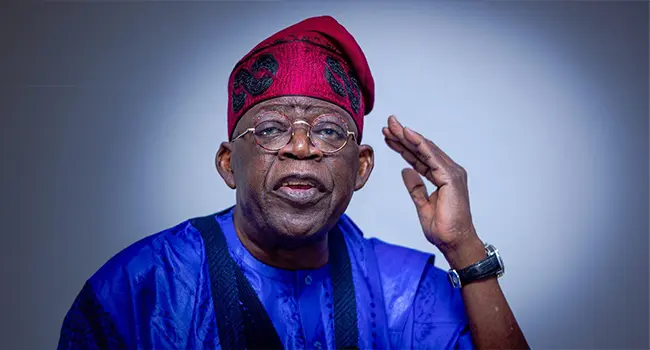
President Bola Tinubu has explained the rationale behind his administration’s recent reforms of the National Youth Service Corps (NYSC), saying the changes are designed to equip young Nigerians with practical skills and better prepare them for national development.
The President said the reforms, approved by the Federal Executive Council on Monday, reflect his administration’s commitment to creating meaningful opportunities for young people.
He disclosed this in a statement posted on his X handle on Wednesday.
“On Monday, at the Federal Executive Council, our administration approved the most consequential reforms of the National Youth Service Corps Scheme since its establishment in 1973,” Tinubu said.
“On the day I was sworn in as your President, I promised to create meaningful opportunities for our young people. I said women and youth would feature prominently in our administration, and this reform is part of the fulfilment of that promise.”
Tinubu said while the NYSC has contributed to national unity for more than five decades, Nigeria’s evolving realities required a broader and more practical mandate.
“For 53 years, the NYSC has served the cause of national unity. That mission remains important and must be preserved,” he said. “But the Nigeria of today demands more.”
“Our young people are nearly 70 per cent of our population. They are not a burden to be managed — they are the engine of our future.”
Skills, safety and new structure
The President said the orientation programme would now be extended to six weeks and restructured to focus on civic responsibility, leadership, entrepreneurship, digital and financial literacy, and career readiness, alongside sector-specific training.
He listed agriculture, health, education, technology, law, public service, infrastructure, the green economy, creative industries, and security services among the areas of focus.
“Every corps member must leave NYSC better prepared for work, enterprise and national service,” he said.
Tinubu also said the reforms would improve safety through a risk-based deployment system, particularly in security-challenged areas.
He explained that postings would prioritise indigenes, residents, graduates of institutions in affected states, and applicants from neighbouring states within the same geopolitical zone.
He added that deployment would be technology-driven, with placements better aligned to corps members’ academic backgrounds and career paths.
Governance and institutional changes
According to the President, the NYSC will now be headed by a civilian Director-General, supported by three executive directors, including one overseeing security matters drawn from the military or paramilitary services.

Orientation camps, he said, will be subjected to a national grading and certification framework, with states required to meet minimum operational standards.
He also announced that the Passing-Out Parade would be redesignated as a Graduation Ceremony, reflecting the expanded training corps members would receive.
“Corps members will no longer merely complete service; they will graduate as trained civic and professional contributors to national development,” Tinubu said.
The President commended the Minister of Youth Development, Ayodele Olawande; his Special Adviser on Policy and Coordination, Hadiza Bala Usman; the Federal Ministry of Education; and members of the reform committee for their contributions.
He directed the Ministries of Youth Development and Justice to begin amendments to the NYSC Act and related regulations to provide legal backing for the reforms.
“To every young Nigerian: this nation believes in you,” he said. “We are building a country worthy of your talent, your ambition and your future.”
