

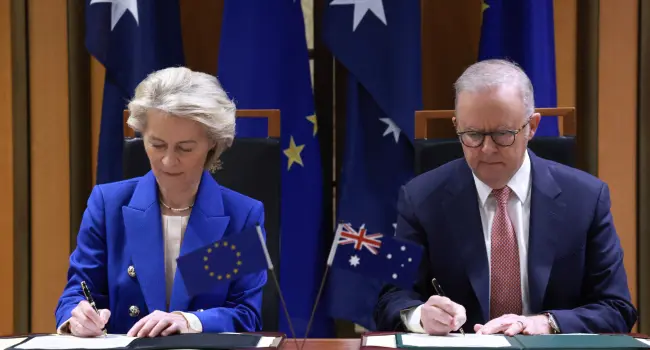
Ursula von der Leyen and Anthony Albanese on Tuesday sealed a long-awaited free trade agreement in Canberra, striking key compromises to boost exports amid growing global trade uncertainty.
The two leaders also agreed on a new defence and security partnership aimed at strengthening cooperation in maritime and cyber security.
“The EU and Australia may be geographically far apart, but we are closely aligned in how we see the world,” von der Leyen said. “At a time of global turbulence, we are sending a clear signal that cooperation and partnership matter most.”
Albanese described the deal as a milestone for Australia, highlighting its significance in securing access to one of the world’s largest economies.
“This is a major moment for our nation as we finalise an agreement with the world’s second-largest economy,” he said.
The agreement comes after eight years of negotiations, with both sides resolving key sticking points, including the use of European geographical names by Australian producers and market access for Australian beef.
Under the compromise, Australian winemakers will be allowed to use the term “prosecco” domestically but must phase it out for exports within 10 years. Producers will also retain the right to use certain established names, such as feta and gruyere, where they have been in consistent use for at least five years.
European carmakers stand to benefit from Australia raising the threshold for its luxury car tax on electric vehicles, a move expected to exempt roughly three-quarters of EVs.
The EU projects its exports to Australia will grow by about one-third over the next decade, with particularly strong gains in dairy and automotive sectors, each forecast to expand by around 50 percent.
For Australia, a major win lies in increased agricultural access. The quota for Australian beef exports to the EU will expand to 30,600 tonnes over the next decade, more than ten times current levels, though still below what farmers had sought. Of this, 55 percent of grass-fed beef will enter duty-free, while the remaining 45 percent will face a reduced tariff of 7.5 percent. The quota will be phased in gradually, with one-third available in the first five years.

The EU will also open a quota of 25,000 tonnes for Australian grass-fed sheep and goat meat, to be introduced over seven years.
The agreement is expected to be formally signed once it receives approval from the European Council.
EU firms exported €37 billion ($42.9 billion) in goods to Australia last year, alongside €31 billion in services in 2024, underscoring the scale of existing economic ties the deal aims to deepen.
AFP
