
The Cambridge Dictionary has named “human” its 2026 Word of the Year, reflecting growing concerns about artificial intelligence and renewed interest in the qualities that distinguish people from machines.
The dictionary announced the selection on Wednesday, saying it captured a growing appreciation of human creativity, connection and authenticity in an increasingly AI-driven world.
According to Cambridge, the choice reflects changing conversations about human identity as artificial intelligence becomes increasingly embedded in everyday life.
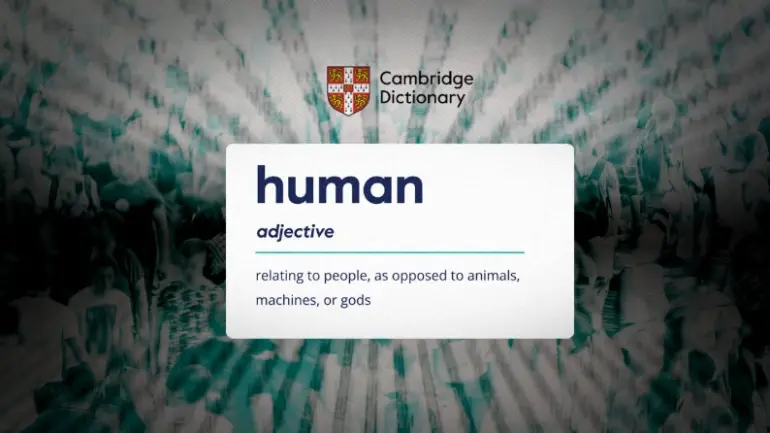
The dictionary defines “human” as having the qualities, faults and feelings associated with people, as opposed to gods, animals or machines.
Its lexicographers also noted a growing use of compound expressions such as “human-made”, as people increasingly seek to distinguish work created by humans from content generated by artificial intelligence.
Cambridge Dictionary lexicographer Colin McIntosh said AI was changing the way people understood and discussed what it meant to be human.
“AI is changing how we talk about being human.
“Fears about what humans may lose when we outsource our thinking have made us reconsider the extent to which we rely on AI: from top mathematicians to teachers of young children,” he said.
McIntosh added that the renewed interest in human identity and the qualities that set people apart from machines had influenced the dictionary’s selection.
Other contenders for the 2026 title included “agent”, referring to an artificial intelligence system capable of performing complex tasks with limited human intervention, and “analogue”, describing activities or objects that do not rely on digital technology.
“Wholesome”, used to describe something that contributes positively to a person’s physical, moral or emotional well-being, was also among the words considered.
Meanwhile, Cambridge highlighted “FOBO”, an abbreviation for the fear of becoming obsolete, as an expression to watch in 2027, amid growing concerns about the potential impact of AI on jobs and careers.

Another expression identified was “weather whiplash”, describing a rapid shift from one extreme weather condition to another.
The selection comes amid intensifying debate over artificial intelligence and its implications for employment, education, creativity and human relationships.
AI-related terminology has featured prominently in recent dictionary word-of-the-year selections. Cambridge chose “hallucinate” in 2023 to describe the production of false or misleading information by AI systems, while Merriam-Webster selected “slop” in 2025 to describe low-quality digital content, often generated by artificial intelligence.
Cambridge Dictionary’s 2025 Word of the Year was “parasocial”, describing a perceived connection with a famous person or fictional character whom someone does not personally know.