

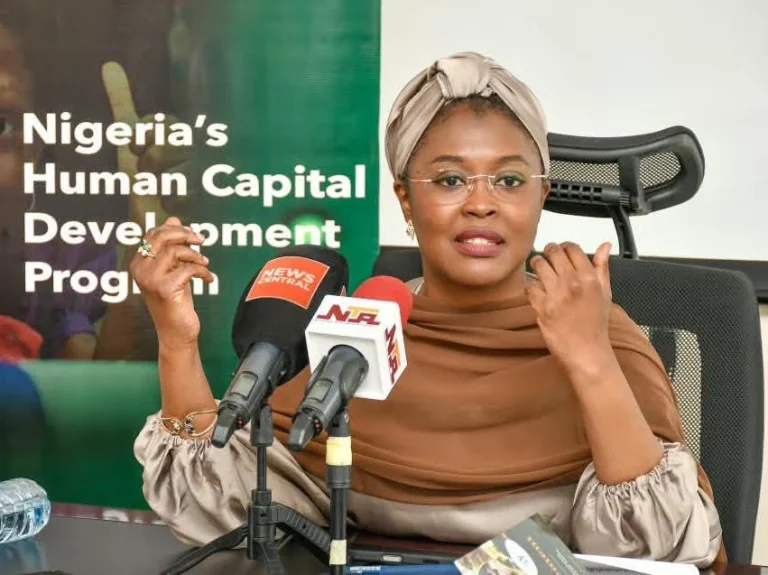
Nigeria is facing a deepening learning crisis, with about seven in every 10 children under the age of 10 unable to read and understand a simple sentence, the National Human Capital Development Programme has said.
The situation, according to the programme, goes beyond the number of children attending school, as many pupils are not acquiring the basic literacy and numeracy skills needed to progress academically and participate productively in the economy.
The National Coordinator of Human Capital Development 2.0 and Special Adviser to the President of the National Economic Council and Climate Change, Rukaiya el-Rufai, disclosed this at a media engagement on Nigeria’s human capital development strategy on Monday in Abuja.
El-Rufai said the scale of learning poverty was particularly worrying because school attendance did not necessarily translate into meaningful learning.
“The one that worries me and scares me is that learning poverty is so high. It’s about 70 per cent. So the numeracy and the English skills from 10 to 12, in fact, the World Bank puts it at 85 per cent. So it’s not that even the kids that are in school, what they’re learning is not sufficient,” she said.
She said the consequences extend beyond the education sector because poor foundational skills can prevent young Nigerians from acquiring the advanced technical competencies required by employers and industries.
El-Rufai cited the experience of the Dangote Refinery to illustrate how weaknesses in basic education could affect the development of a skilled workforce.
“I know this kind of thing, you can’t even, it’s just like when Dangote was building the refinery, they couldn’t train our welders because to achieve that precision you need geometry. You need geometry,” she said.
According to her, Nigeria could have large numbers of young people in schools and in the labour market without equipping them with the skills required to secure productive and well-paying jobs.
“So some of, even the sophisticated skills and some of the jobs that meet the needs of our industries and our sectors, you can’t even sell that with the current level. So you see it’s a lot, and then the youth are not in employment, education and training,” she said.
Six priority areas
The Human Capital Development 2.0 programme is focusing on health, education, skills and livelihoods as part of efforts to improve Nigeria’s human capital outcomes.
El-Rufai said six indicators had been identified as priorities: under-five mortality, stunting, immunisation, out-of-school children, learning poverty, and young people not in employment, education or training.
She said the programme had also changed its approach from simply tracking activities to measuring outcomes that could contribute to an improvement in Nigeria’s Human Capital Index.
The initiative is being implemented through the National Economic Council, which provides a platform for cooperation between the Federal Government and state governments.
El-Rufai said the involvement of states was critical because human capital challenges differ considerably across the country.
“We have been having regional sessions with the states in regional blocks because the results are so polarised. You look at the north, you see; you look at the south. So it shows us that there’s no one-size-fits-all. Because what we’ve done is we have this national framework. Each state is now developing theirs.
“So they’re picking based on the nuances of their own developmental challenges. They are coming up with their own HCD plans,” she said.
She said the state-specific approach would enable governments to focus resources on their most pressing challenges while building on areas where they had recorded progress.
El-Rufai cited differences in school enrolment across states as one example of why interventions need to reflect local realities.
She added that the programme would rely increasingly on data to identify areas where interventions and resources were most urgently required.
Media urged to track human capital investment
The Director of Advocacy and Communications at the programme, Doosuur Zasha, said investment in human capital was central to Nigeria’s economic development.
She urged the media to play a stronger role in monitoring government spending on human capital and assessing whether such investments were producing measurable improvements in the lives of Nigerians.
“That’s the core of what we’re doing here. At the core of it, we’re trying to see how Nigerians can access quality healthcare, whether children are learning, and whether young people and adults have the skills and opportunities to earn a decent livelihood, and if people that face barriers can actually have full participation in the economy,” Zasha said.
She said improving human capital outcomes would require sustained attention to healthcare, education, skills development and access to economic opportunities.
The HCD 2.0 programme builds on the earlier Human Capital Development initiative established under the National Economic Council. It is supported by development and private-sector partners, including the Bill & Melinda Gates Foundation and the Aliko Dangote Foundation.