

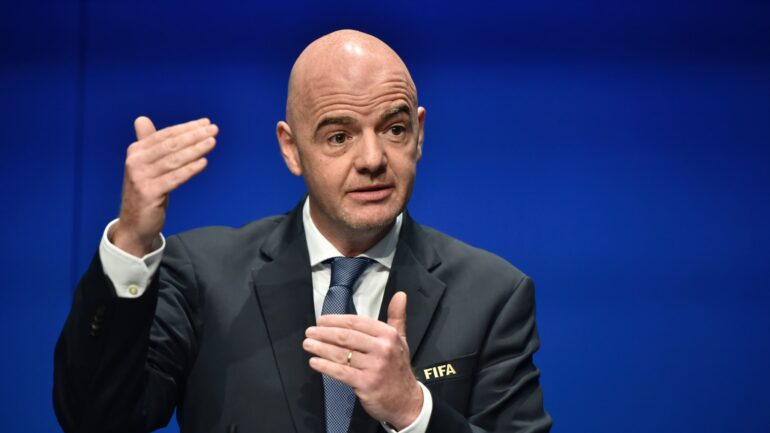
Embattled FIFA president Gianni Infantino on Thursday faced the prospect of legal action from UEFA over his now-shelved plan to introduce private financing into the World Cup, with European football’s governing body accusing him of potential “criminal mismanagement.”
The 56-year-old Swiss head of world football’s governing body, however, received some respite later in the day when UEFA announced it was withdrawing, “on a provisional basis”, its threat to boycott FIFA competitions.
The decision will come as a relief to Poland, which is scheduled to host next month’s FIFA Women’s Under-20 World Cup.
But the threat of a boycott — widely viewed as a key factor in forcing Infantino into a humiliating U-turn just days after unveiling the controversial proposal last month — remains on the table.
Following a meeting of European football’s member associations in Monaco, UEFA said it had “agreed to suspend, on a provisional basis, the withdrawal by European teams from FIFA competitions in the coming season”.
“This position will remain under constant review and may be reconsidered immediately if circumstances so require,” UEFA said.
While the provisional suspension may ease pressure on Infantino, whom UEFA has urged to resign, the prospect of legal action presents a more serious challenge.
“UEFA is actively considering legal action arising out of and in connection with the… plan proposed by FIFA,” said a legal document seen by AFP that is to be filed in a Florida court in the United States.
The filing seeks permission to gather evidence for a potential criminal complaint in Switzerland, where both UEFA and FIFA are headquartered.
“More specifically, UEFA and other interested parties are preparing to bring criminal claims in Switzerland against Infantino and possibly other FIFA officials and advisors for criminal mismanagement under Article 158 of the Swiss Criminal Code,” the document said.
‘Serving football’
UEFA has requested access to a wide range of documents relating to the development of FIFA Forward Enterprise (FFE), the proposed private-financing initiative.
Among the documents sought are records relating to a meeting held at a New York City hotel on the eve of last month’s World Cup final, attended by several senior FIFA directors who were reportedly briefed on the plan.
The New York Times reported that two of the five directors present refused to approve the proposal. One of them was FIFA chief operating officer Kevin Lamour, who has since left the organisation.
If UEFA succeeds in obtaining the documents, it intends to pursue the complaint in Switzerland. The governing body said it had been advised that the case met the requirements for consideration by a Swiss court.
“On information and belief, Infantino’s actions described herein rise to the level of criminal mismanagement,” UEFA said.
Infantino had been expecting a relatively smooth path to re-election next March in Rabat, where he was hoping to secure a fourth and final term after overseeing what was widely regarded as a successful World Cup.
Instead, his private-financing proposal has triggered an unprecedented backlash from several of football’s major confederations.
UEFA has been among his most outspoken critics, describing the proposal as a “shady, opaque backroom deal”, while also receiving support from CONCACAF and the Asian Football Confederation (AFC).
CONCACAF president Victor Montagliani is widely regarded as the most likely potential challenger to Infantino, although UEFA president Aleksander Ceferin has ruled himself out of the race.

The three confederations have maintained pressure on Infantino and earlier this month issued a strongly worded joint letter.
“Leadership in football is not a possession. It is not about holding — or demanding — power to be held,” they wrote.
“When trust is broken through deception, when an individual places himself above the collective that entrusted him with authority, that duty has been abandoned,” they added.
Infantino still retains influential allies. Saudi Arabia, host of the 2034 World Cup, expressed support for him on Thursday, while the Confederation of African Football (CAF) and South American football confederation CONMEBOL have also backed his position.
UEFA, however, showed no sign of softening its stance, ending Thursday’s statement on the boycott suspension with a pointed message.
“FIFA must once again be governed as an institution serving football — not operate as an instrument of individual power,” it said.
AFP