

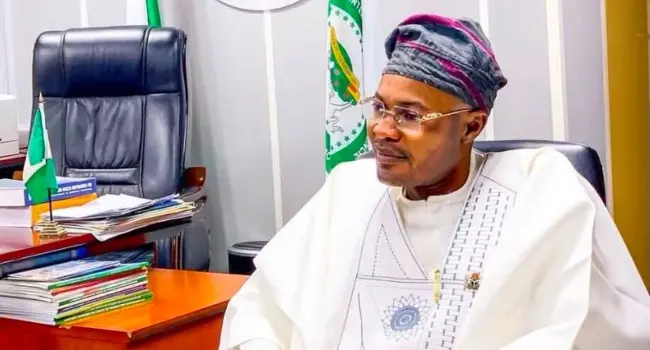
The Budget Office of the Federation has told the House of Representatives that none of the funds appropriated for the controversial Presidential Economic Advisory Council/Presidential Foreign Intervention Promotion Council (PEAC/PFIPC) was spent, insisting that the conditions required for releasing the money were never met.
Director-General of the Budget Office, Tanimu Yakubu, made the disclosure while appearing before the House ad hoc committee investigating the establishment and budgetary provisions of the disputed council.
According to Yakubu, although the National Assembly approved funds for the PEAC/PFIPC, no disbursement was made because the statutory and administrative requirements for spending public funds were not fulfilled.
“The conclusion is firm. Not one kobo of the personnel provision could lawfully have been drawn, and not one kobo was drawn. The overhead provision never matured into a lawful cash release.
“The capital provision never matured into procurement or expenditure. The conditions required for spending were not met and were not close to being met. There is therefore no personnel expenditure to recover. The money never moved because the controls held,” he said.
Yakubu explained that the Budget Office withheld financial clearance, no recruitment or payroll was approved, and both the Federal Ministry of Finance and the Office of the Accountant-General of the Federation were directed not to process any payment.
He added that the office would continue to cooperate with the House committee by providing all relevant records and documents to support its position.
The Budget Office’s submission comes amid an ongoing controversy over the PEAC/PFIPC, whose purported Director-General, Adeniyi Adeyemi, publicly operated as head of the agency despite repeated denials by the Presidency that it exists.
For months, Adeyemi was seen in photographs with diplomats and prominent Nigerians and reportedly operated from an office at the Federal Secretariat in Abuja.
Although the Presidency has described the agency as non-existent and filed criminal charges against him, Adeyemi has maintained that his appointment was valid. He has also accused the President’s Chief of Staff, Femi Gbajabiamila, of receiving money through an intermediary to facilitate the appointment—an allegation Gbajabiamila has denied and taken to court. Adeyemi was subsequently arrested in Osun State.
As part of its investigation into the controversy and the ₦1.3 billion appropriated for the council in the 2026 Appropriation Act, the House committee has also questioned officials of the Central Bank of Nigeria (CBN), security agencies and the Office of the Head of the Civil Service of the Federation.
Earlier this week, the CBN disclosed that it opened two accounts for the disputed agency on the instruction of the Office of the Accountant-General of the Federation but said neither account was ever activated or funded.
“Like I said, the accounts have never been operated. As a result, there have not been any foreign exchange allocations to the council from CBN. There have not been any remittances into those two accounts. There have not been approvals because the authority has not been established for those who will operate the account,” CBN Director of Banking Services Abdullahi Hamisu told the committee.
Also appearing before the lawmakers, Head of the Civil Service of the Federation, Didi Walson-Jack, said her office neither allocated office space at the Federal Secretariat nor deployed civil servants to the council.
“The request for deployment of officers was received and noted for consideration. However, there was no deployment of officers by the Office of the Head of the Civil Service of the Federation to the council,” she said.
She added that despite reports suggesting the council occupied office space at the Federal Secretariat Phase Three, her office did not allocate any accommodation to the agency.
The Independent Corrupt Practices and Other Related Offences Commission (ICPC) has also invited Gbajabiamila for questioning as part of its investigation into the controversy, following President Bola Tinubu’s directive for a comprehensive probe.