

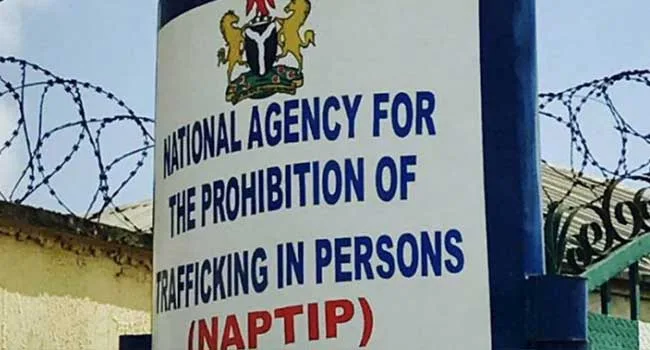
The National Agency for the Prohibition of Trafficking in Persons (NAPTIP) has rescued 156 victims of human trafficking since January 2026 and repatriated more than 300 Nigerians from Ghana and Côte d’Ivoire in 2025.
The agency also warned that traffickers were increasingly shifting their operations from traditional locations such as brothels and farms to the digital space, where educated and tech-savvy Nigerian youths are being lured into forced online scam operations in parts of Southeast Asia.
NAPTIP Director-General, Binta Bello, disclosed this on Wednesday at a pre-World Day Against Trafficking in Persons press conference held at the agency’s headquarters in Abuja.
The event was attended by representatives of the United Nations Office on Drugs and Crime (UNODC), International Organisation for Migration (IOM), International Centre for Migration Policy Development (ICMPD) and the Embassy of the Kingdom of the Netherlands ahead of the 2026 World Day Against Trafficking in Persons, marked annually on July 30.
The theme for this year’s commemoration is “Trapped Behind the Scam.”
Bello said traffickers were now targeting young Nigerians with promises of well-paying jobs abroad in sectors such as information technology, digital marketing, customer service, cryptocurrency trading, gaming and telecommunications.
“Upon arrival in foreign countries, especially parts of Asia, they discover that the promised jobs do not exist. Instead, their passports are confiscated, their freedom is restricted, and they are forced under threats, intimidation, violence, debt bondage or psychological coercion to perpetrate sophisticated online scams,” she said.
She said more than 300,000 people are trafficked into scam operations across Southeast Asia annually, generating an estimated $64 billion in proceeds.
According to her, victims from about 66 countries have been identified in such operations, with a significant concentration of scam compounds in Myanmar, Cambodia, Thailand and Laos.
Describing the conditions faced by victims, Bello said those who fail to meet targets are subjected to severe punishment, including confinement, torture, sexual abuse and other forms of exploitation.
“Families lose contact with their loved ones. Parents exhaust their savings in desperate attempts to secure what they believe are legitimate overseas opportunities,” she said.
The NAPTIP boss said the emerging trend posed a serious national security threat with long-term social and economic consequences.
She explained that traffickers typically recruit victims through online platforms, including social media job pages, where they advertise fake overseas employment opportunities, scholarships and remote work.
According to her, victims are then isolated through digital grooming, charged illegal travel facilitation fees through informal channels and eventually transported to foreign compounds where they are forced to carry out online fraud under threats.
Bello said NAPTIP’s Cyber Response Team had disrupted several domestic scam networks operating as “fraud academies” and had arrested individuals involved in training young Nigerians for cyber-enabled crimes.
She added that those arrested were being prosecuted.
The NAPTIP boss also disclosed that the agency recently intercepted and rescued 46 suspected trafficking victims at the Nnamdi Azikiwe International Airport, Abuja, who were allegedly being trafficked to security-challenged countries in the Middle East.
She said another 120 victims were rescued in Kano.
On prosecution, Bello said NAPTIP had secured 839 convictions since inception, including 47 convictions between January and July 2026.
She said the agency had also successfully prosecuted high-profile traffickers, including a case in Ondo State where a trafficker and his wife were convicted and properties worth millions of naira forfeited.
The UNODC Country Representative, Cheik Touré, said combating human trafficking required more than enforcement, stressing the need to create economic opportunities for young Nigerians.
“Trafficking thrives where legitimate opportunity is scarce. Young people who cannot find decent jobs at home become the very population that traffickers seek out,” he said.
Touré urged stakeholders to invest in skills development and employment creation, describing youth empowerment as a major defence against trafficking.

He also called on the media to adopt survivor-centred reporting practices that protect the dignity of victims.
Meanwhile, the Chief of Mission of the International Organisation for Migration, Dimanche Sharon, said young people remain the most affected group, with those aged 18 to 25 accounting for about 54 per cent of assisted trafficking victims.
She said IOM had assisted more than 7,600 trafficking victims in Nigeria since 2017, providing support in areas including protection, rehabilitation, voluntary return and reintegration.
Sharon stressed that victims forced into online fraud schemes should be treated as victims of trafficking rather than criminals.
“Trafficking for forced criminality is a form of trafficking in persons. Victims compelled to participate in these activities remain victims and should be identified, protected and assisted,” she said.
The Head of Office of ICMPD Nigeria, Isabelle Wolfsgruber, said the organisation had reached more than 80,000 students, 1,000 teachers and 6,000 parents through anti-trafficking education programmes across Benue, Delta, Edo, Enugu and Ogun states.
She added that more than 345 investigators, prosecutors and judicial officers had received training on cybercrime and digital evidence to strengthen responses to modern trafficking cases.
The First Secretary on Migration at the Dutch Embassy, Sib Siebesma, said the Netherlands remained committed to supporting Nigeria’s anti-trafficking efforts through various programmes focused on prevention, protection and prosecution.
Activities marking the 2026 World Day Against Trafficking in Persons include public sensitisation campaigns, awareness walks, survivors’ engagement programmes and sporting events scheduled between July 24 and August 1.