

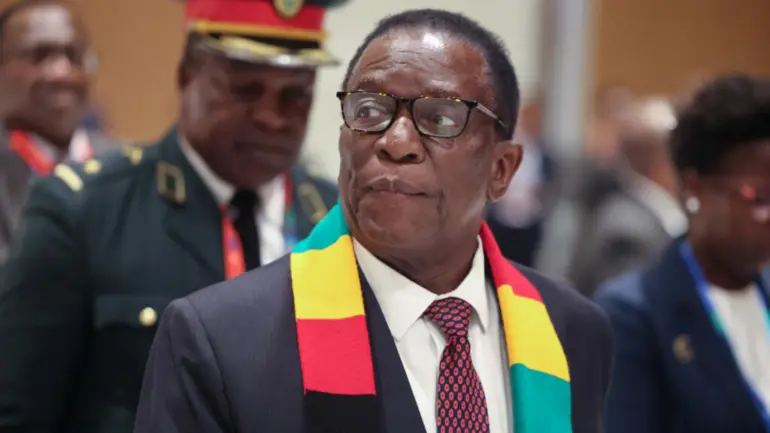
Zimbabwe’s Senate on Wednesday overwhelmingly approved a set of controversial constitutional amendments that could allow President Emmerson Mnangagwa to remain in office until 2030, completing the legislation’s passage through Parliament.
The amendments, among the most divisive political reforms proposed in recent years, now await President Mnangagwa’s assent before they can become law.
Announcing the outcome of the vote, Senate President Mabel Chinomona said 75 senators voted in favour of the bill, while four opposed it.
The legislation had earlier secured approval in the National Assembly on June 18, where 216 lawmakers voted in support and 42 against.
The proposed changes, which critics have described as a “constitutional coup,” include extending presidential and parliamentary terms from five years to seven years.
If enacted, the amendments would effectively prolong Mnangagwa’s final constitutionally permitted term beyond its current expiration date, allowing him to remain in office until 2030.
Another key provision would transfer the power to select the president from voters to Parliament, reversing the system of direct presidential elections introduced in 1987.
The reforms have sparked fierce opposition from critics, who argue that they would further entrench the dominance of the ruling Zanu-PF party, which has governed Zimbabwe since independence in 1980 and maintains a commanding majority in Parliament.
Opposition groups contend that the amendments would weaken democratic institutions and consolidate power within the ruling party.
Activists campaigning against the proposals have reported intimidation, harassment and violence, including arrests and alleged assaults by suspected state agents.
Efforts to halt or overturn the constitutional amendment process through the courts have so far been unsuccessful.
Mnangagwa, 83, came to power in 2017 following a military-backed intervention that ended the nearly four-decade rule of former president Robert Mugabe. He was subsequently elected president in 2018 and re-elected in 2023.

When the cabinet approved the proposed amendments in February, the government said the reforms would promote political stability and policy continuity, enabling development programmes to be completed without disruption.
However, rights groups have voiced concerns about the process. In March, Human Rights Watch accused authorities of using intimidation and violence against opponents of the amendments.
“Over the last few months, the police and unidentified armed men have threatened, harassed, and beat up several people who are opposed to the proposed constitutional amendment,” the organisation said.
The amendments are expected to remain at the centre of Zimbabwe’s political debate as the country prepares for future elections.
AFP
