
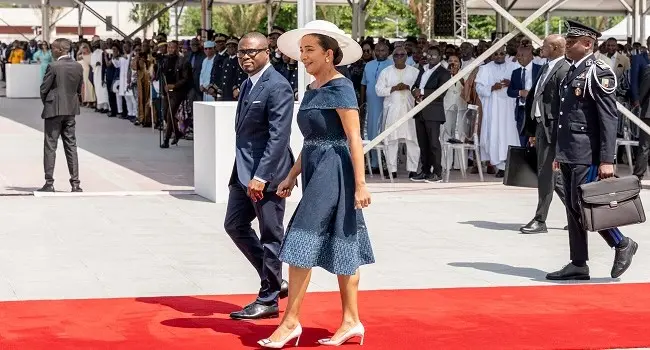
Romuald Wadagni, Benin’s former finance minister, was officially sworn in as the country’s president on Sunday, succeeding his predecessor and former boss, Patrice Talon.
An economist widely regarded as a technocrat and continuity candidate from Talon’s two terms, Wadagni was elected on April 12 with 94 percent of the vote.
His only challenger, Paul Hounkpe, was decisively defeated, with his party later aligning with Wadagni’s political bloc in parliament.
The main opposition party, The Democrats, was excluded from the race due to insufficient endorsements and internal divisions.
“I will serve Benin with integrity, courage and commitment,” Wadagni said at his inauguration, adding: “Power is never a personal privilege.”
Wadagni takes leadership of a West African nation that has recorded strong economic growth over the past decade, but continues to grapple with significant inequality and rising insecurity in its northern regions due to attacks attributed to jihadist groups.
The 49-year-old begins a seven-year term following a constitutional reform last year that extended the presidential mandate from five to seven years. Presidents remain limited to two terms.
During his decade-long tenure as finance minister, Wadagni oversaw fiscal reforms that strengthened public finances and reduced the budget deficit by roughly one-third to around three percent of GDP.
He pledged to combine economic discipline with a firm security strategy to address violence in the north, linked primarily to Al-Qaeda’s Sahel affiliate, the Group for the Support of Islam and Muslims (JNIM).

“Benin will not give in to fear or complacency. The government will be firm against all those who threaten our unity and security,” he said.
A key challenge for his administration will be stabilising relations with neighbouring Niger and Burkina Faso, both governed by military juntas and heavily affected by Islamist insurgencies spreading across the Sahel.
Signalling a possible thaw in relations, Niger’s Prime Minister Ali Mahaman Lamine Zeine attended the inauguration ceremony, drawing applause from attendees.