
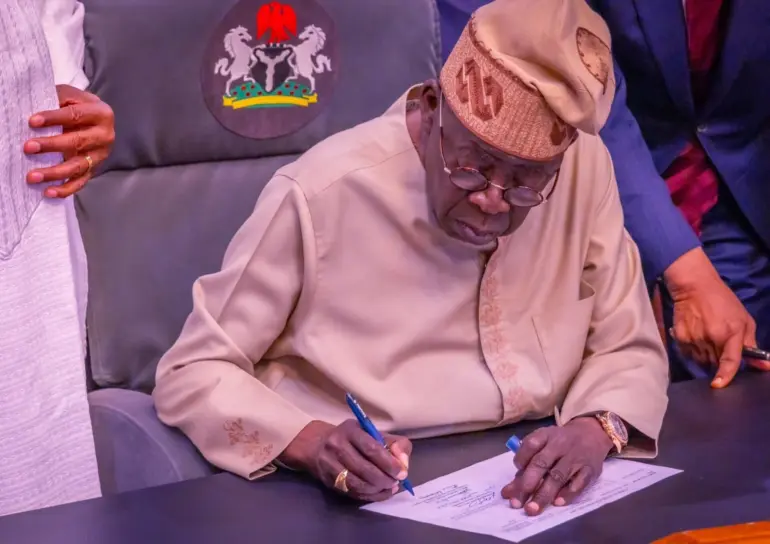
President Bola Tinubu has signed the 2026 Appropriation Bill into law, approving a total expenditure of ₦68.32 trillion.
He also assented to an amendment extending the implementation period of the 2025 budget from March 31, 2026, to June 30, 2026.
The development was announced on Friday in a statement by the President’s Special Adviser on Information and Strategy, Bayo Onanuga.
The 2026 budget allocates ₦4.799 trillion for statutory transfers and ₦15.8 trillion for debt servicing. Recurrent expenditure is set at ₦15.4 trillion, while ₦32.2 trillion is earmarked for capital projects through the Development Fund.
According to the statement, capital expenditure accounts for roughly 50 per cent of the total budget, reflecting the administration’s focus on economic stability, national security, infrastructure development, and inclusive growth. It added that the allocations strike a balance between statutory obligations, debt servicing, recurrent costs, and investments aimed at boosting productivity and improving living standards.
President Tinubu also signed the Appropriation (Repeal and Enactment) (Amendment) Bill, 2026, which extends the capital component of the 2025 budget to June 30, 2026. The extension is intended to ensure full utilisation of funds, particularly for critical infrastructure and development projects already at advanced stages.
The government said the move would enable ministries, departments, and agencies (MDAs) to complete ongoing projects, improve delivery rates, and maximise value for public spending. With the 2026 budget taking effect from April 1, full implementation is expected to proceed in line with the administration’s Renewed Hope Agenda.
The President directed MDAs to ensure disciplined, transparent, and efficient use of public funds, with a strong emphasis on value for money and timely project execution. He also commended the National Assembly for its cooperation and swift passage of the budget, reaffirming the importance of continued collaboration between the executive and legislative arms of government.
Tinubu further assured Nigerians of his administration’s commitment to fiscal reforms, improved revenue generation, and strategic investments to drive economic growth, create jobs, and strengthen social protection systems.
The budget will be partly financed through external borrowing, following the approval of a foreign loan plan exceeding $21 billion to bridge the fiscal gap.
Budget increase
The 2026 budget represents an increase of ₦9.85 trillion from the initial proposal of ₦58.47 trillion submitted to the National Assembly, and ₦13.33 trillion higher than the 2025 budget.
While presenting the proposal in December 2025, President Tinubu projected capital expenditure at ₦26.08 trillion and set the crude oil benchmark at $64.85 per barrel. He estimated total revenue at ₦34.33 trillion and debt servicing at ₦15.52 trillion.
The proposal was based on an oil production target of 1.84 million barrels per day and an exchange rate of ₦1,400 to the US dollar.

Focus on security and agriculture
Amid rising security concerns, the President said his administration would prioritise defence spending with strict accountability.
“Security spending must deliver measurable results,” he said, adding that food security would also remain a key priority.
He outlined plans to strengthen agricultural markets through investments in input financing, mechanisation, irrigation, climate-resilient farming, storage, processing, and agro-value chains.
Government position
In recent years, Nigeria’s budgets have faced criticism over poor implementation and delays in fund releases. However, the administration maintains that the 2026 budget is designed to consolidate ongoing reforms and accelerate national development.
Describing it as a “Budget of Consolidation, Renewed Resilience and Shared Prosperity,” the Minister of Information and National Orientation, Mohammed Idris, said it reflects a commitment to building on existing progress and delivering tangible benefits to Nigerians more quickly.